When you get more kudos for your entry that simply reads “it’s such a nice day that I don’t think I’ll post anything today” than any of your other entries, it’s time to pack it in.
May 25, 2009
May 24, 2009
The great dragon of the eastern desert
OK, this is taking many more words than I anticipated. Many more words.
I’m going to post the first chapterish thingy in a moment. You might want to get a cup of coffee, or your favorite alternative stimulant, before you begin.
I’ll make some editing passes later…
Comments Off on The great dragon of the eastern desert
GDotED: chapter 1
By the second year of the reign of young Queen Ling, the town of Chengzu, at the south-eastern frontier of the empire, had been almost forgotten. The older generation of its inhabitants remembered when the town thrived as a center of mining and shipping, but the peace made between Queen Lings father and the Sea Kings had put an end to its wealth. With commerce open via sea to the strange kingdoms to the south and west, beyond the impassible great eastern desert, it was less expensive to import gold and other minerals from across the sea than to mine them locally. In a matter of months, the wealthy merchants had left the town, in search of riches elsewhere. They were followed by the miners and metal workers, and then many of the other merchants.
Many of the residents of Chengzu, however, chose to stay. During its period of wealth, the town had been built well, and it remained a good place to raise a family, and was far from the intrigues, crime, and intolerance of the greater cities of the north. As groups of people left the town to find greater fortune elsewhere, they were replaced by people who sought a simpler life and content to work the fertile farms in the lower valley. They were also joined by people escaping from troubles of undisclosed natures in other parts of the kingdom. In both the figurative and literal senses, Chengzu is as far as someone can get from the rest of the empire without crossing the sea.
The social barriers so obvious in the heart of the kingdom were attentuated here. Members of obscure religions openly displayed symbols of their faith, a simple act that might have cost them their lives in other parts of the empire.
It was not unusual for the children of the families of Chengzu to play together, without regard to the ancestry or caste of their parents, and to explore well beyond the boundaries of the town during the course of their daily play, but it was very unusual for them to fail to return to their homes well before sunset.
—-
Ai Danning, caretaker of the facilities of the great gold mine, spent much of his time in Chengzu.
The facilities were located several miles outside of the town, at the foothills of the barrier mountains surrounding the great desert. They consisted of a group of buildings as large as a small village. The buildings were unoccupied because the mine was closed and the weather here was too windy and arid for farming.
His primary responsibility was to keep the facilities near the mine ready to restart operations, should the price of gold ever rise to the point where that made economic sense. Given the arid conditions and lack of people, this was an easy job. His most difficult chore, as far as most of the residents of Chengzu knew, was to keep squirrels, skunks, and raccoons from nesting in the old buildings. Some of the Chengzu folks thought he was crazy to spend time sweeping the walks, pruning back the slow-growing brush that grew in the sheltered areas between the buildings and along the road, and re-painting the buildings every year. Some of the others thought that he would probably go crazy if he hadn’t found ways to keep himself busy.
Although part of his job was to protect the mining facilities from being looted for equipment or raw ore stolen from the mine itself, there was little need for him to actually stand guard on the premises. It would be impossible for anyone to remove any of the heavy equipment except via the old road, which ran through the heart of the town, and the idea of working the mines themselves was nearly as unthinkable, because it would take a large crew to simply reopen the entrances. If such a crew appeared at the mine and attempted to restart the operation, Danning simply had to send a message to the garrison at Minlong, two days ride to the north, who would send a detachment to halt the work before it could progress very far. This meant that he could effectively keep an eye on the mine from several miles away, sitting in a small pub on the road, and this is how he occupied many of his days.
There had been a small amount of speculation and accompanying rumor about how Danning had gained his employment by the mining company, which was now owned by a corporation with offices in a distant city. All that most people knew was that the Danning had arrived in Chengzu early one autumn morning eight years ago, and, after spending several days exploring the town, had gone to visit the caretaker of the mines, an eccentric man who had been caretaker for almost ten years but who was virtually unknown in the town. Several days later, Danning returned through Chengzu and returned up the road. Seven weeks later, he returned to Chengzu, bearing letters from the mining company that named him caretaker of the mines. The previous caretaker then left Chengzu. Some of the farmers who were up very early that morning thought they saw a lone figure walking northward on the road, and although they they could not be sure that it was old caretaker, they assumed that it was. In any case, the caretaker and his possessions were gone from Chengzu, and most people were completely satisfied with Danning’s explanation that the previous caretaker had found the the job tedious and had decided to return to distant land of his ancestors.
In the seven years Danning had served as caretaker, there had been no attempts to steal anything, and the mine buildings were cleaner and better maintained than they had ever been during the operation of the mine. The most frequent visitors Danning had ever seen at the mine were young lovers who desired a clean and private place for undisturbed trysts, or young children exploring. For their sake, Danning always made sure to leave all of the buildings unlocked, with the exception of his personal hut. Nobody ever left much of a mess, and what mess they did leave behind was less trouble to clean up than replacing locks or broken windows.
There was very little traffic on the road itself. There wasn’t much reason to take the old road south out of town any more. After passing the old mines, the road ascended to the base of the barrier mountains and then snaked its way through a high, narrow pass before descending again to edge of the great desert. Nobody in Chengzu remembered why the road had been constructed, or even had a good theory about it. Many of the young men from Chengzu, curious about the road, had traversed the pass, but all had returned after seeing the vast emptiness of the desert. It would be suicide to try to cross it, a theory that that was supported by the fact that nobody, not even in fairy tales told to the children of Chengzu, had ever come out of the desert.
Besides the curious young men from the town, there were occasional travellers, richly attired but always riding alone, who would pass through Chengzu and continue down the road. They would often stop at the mines to use the well, and Danning would always be there to talk to them. Sometimes the conversation would be brief, but other times the rider would stay with Danning for as much as several days. At the end of their visit, some of the riders would retrace their steps to Chengzu, but most would continue along the road, pass over the mountains, and disappear into the desert. None of these riders was ever seen again.
It was usually the case that Danning would visit the Chengzu postmaster within a week after the departure of these riders, leaving a small parcel addressed to one of the great cities. Then Danning would spend the rest of the day at the pub.
—–
Five days before the new moon, three men rode into Chengzu. The were equipped for prospecting, asked the local officials for maps of the surrounding area and what land might be fallow or for sale. They were strangers to the town, but were treated with polite deference, as were all visitors.
The men stayed at the inn adjoining the pub that Danning frequented. When they had been in town for two days, Danning came to town to buy supplies, and heard of the three men. They were only asking about areas to the north of the town, and nothing near the mine, so Danning did not find the news very interesting. The innkeeper thought it unusual when Danning decided to stay at the inn that night instead of returning to the mine, because his usual custom was to return to the mine every night, unless the weather was bad or there was a late event in the town. This was not a festival evening, and the weather was unusually pleasant. The innkeeper supposed that perhaps Mr. Ai had, at long last, taken interest in a local woman.
There had been idle rumors that Danning and Xiu Feng, the former waitress at the pub, had spent some time alone together, but that had been at least six years ago, and most of the town residents no longer considered private conversations between unmarried men and women to be worthy of special note. In any case, shortly after these rumored conversations Feng had married Chen Long, the town blacksmith, with whom she had had an understanding for more than a year before Danning’s first appearance in Chengzu, and their union had been blessed only a year later with the birth of their son, Chen Zhang. There were no further talks of impropriety, but the innkeeper, who had a long memory, wondered about Danning’s apparent interest in Feng and whether Danning was lonely, living in an empty village, miles from his nearest neighbor. Perhaps Jingjing, the new waitress, had caught his eye, as she had of so many of the single men in the town.
The three prospectors took dinner in their room at the inn, and did not leave their room until dawn the next morning, when they settled their bill and left town.
Danning played cards with acquaintances in the pub until late in the evening, and then retired to his room in the inn, where he slept until mid-morning. By noon he was seated at a table overlooking the road in the pub. He spent the afternoon eating a long meal, chatting with the other guests, and reading from several large books he had borrowed earlier in the day from the local constable. He was still there one hour after sunset, when Long came looking for him.
As the shadows lengthened in the late afternoon and Feng began to prepare dinner for Long and Zhang, Feng had no concern for the safety of her son. It was not until Long returned from the smithy without Zhang and she realized that it was only an hour before sunset that she began to feel any concern. Lately some of the local children had been playing in a nearly dry creek about two miles outside of town, and Long had often been with them, but all of the children knew to be home before sunset. There were still dangerous beasts in the woods surrounding the town, and dusk was their favorite time to hunt. Small children were not safe outside the town at night, and all of them had been told many stories about what might happen were they to be caught outside in the dark.
She sent Long looking for Zhang among the neighbors, but all were accounted for except Zhang and May, who had last been seen playing in the creek several hours earlier. Xiang, May’s father, who had just returned from his work at the mill, exchanged glances with Long. Xiang grabbed his hunting bow from beside the door, and Long shouted across the street to Feng that they were going to look for the children at the creek.
The men set off at a brisk pace. They could easily make it to the creek before dark, but doubts were beginning to enter their minds. If the children had wandered, they could be far from the road by now. Zhang is really old enough to have much sense about danger, and May is not much older. The men did not discuss their fears with each other, but each privately considered the possibility that their children might be under the eyes of one of the large mountain cats already.
When the farmers heard Long and Xiang shouting for assistance, there was never any question that they would stop and help. They knew the men and recognized the voices coming from the gathering darkness. In a moment, they saw Long approaching at a dead run. He quickly explained that he needed to reach Chengzu immediately, and there was a look on his face that left them without any doubt that he was serious. Before Long could even ask, the workers began unhitching one of the horses from the cart. It was an awkward rig, but the horse was docile and Long was an excellent horseman. In a moment, the horses galloping hoof beats were fading in the distance.
A moment later, Xiang came out of the gloom, carrying May. She was limp and unconscious, and her legs were bound by a thin rope. A thin line of dried blood ran from her left nostril down to her chin.
The farmers lay May in their wagon and the Xiang climbed in next to her. All of the farmers except the driver remained on foot, to make the load as light as possible, and the driver set off for town at the best pace possible with the remaining horses. Xiang tossed the walkers his bow and quiver.
The farmers were silent until Xiang was out of earshot.
“Something terrible has happened,” said the eldest. “Something terrible.”
“Why would May be tied like that?,” wondered the youngest.
“Xiang didn’t seem as upset as Long. Long was panicked,” remarked the eldest.
“I wonder where Zhang is,” commented the youngest.
“Well, he’s not here,” replied the eldest. “He’s probably somewhere safe and snug. Long wouldn’t have left him alone out here.”
—–
Long could hardly remember the events of the next hour. He knew he talked to the constable, and remembered what a difficult time he had had getting the constable to understand until he showed him the ransom note.
The constable turned pale and said nothing for a moment, and then a look of measured fury crept over his features. In a moment the fury had passed, and was replaced with a hard look. “Go home, Long. We’ll take care of this. There’s no use in bumping around the hills in the dark, but I’ll send someone up the road tonight to raise the garrison in Moot and when the sun rises tomorrow morning the road north will be closed and every man in this town will be searching the hills for your son. But for now, go home. Feng is going to need you, and there’s nothing you can do here.”
“I think it was the three strangers.”
“I think you’re right. But they’re on foot, leading a mule. Even if they are hours ahead of us right now, they won’t get to Moot before my man. They’ll close the bridge and close the docks. They won’t get past Moot, and that means they’re going to be in the hills. We’ll find them. The only other place they can cross the river is at Cull. That’s three days from here. They won’t get there before we will.”
“I don’t care about catching them. I care about my boy. Do you think we’ll be able to get him back? Should we pay the ransom?”
“Long, do you have that kind of money?”
“No, but I will try to borrow it. People owe me favors. I can put it together.”
“Go home. Feng needs you.”
—–
After a long minute of stunned silence, followed by silent crying, Feng looked up at her husband and told him, in a tone of voice that permitted no discussion, that he must find Danning and tell him what happened and ask for his help.
Long found Danning in the pub. Danning had already perceived that something was afoot in the town. It was not an ordinary occurrence for the constable’s sergeant to go tearing off at full gallop down the road after sunset.
“Mr. Ai, I request your assistance in a matter of great urgency. My son has been kidnapped.”
Danning motioned for Long to sit down.
His prepared speech expended, Long continued with less composure. “The kidnappers have asked for a ransom. It is a huge amount of money. I do not know how I can get it. But I’m worried that it won’t make a difference. The constable wants to catch the kidnappers. I just want back my son.”
Danning did not respond, except to raise his hands from his lap and lace his fingers together, with is index fingers pointing outward. Long paused for a moment and continued in a lowered voice.
“Feng told me to ask for your help. She believes you can help us. And she wanted to make sure that you knew that it was her idea. She said to tell you this: she believes you can help. And I beg you for myself, if there is something you can do to help, please help us.”
Danning exhaled slowly, and then asked, “Did she tell you why she believes that?”
“No. She just said to tell you that she believes. I don’t know why.”
Danning closed his eyes and rubbed his temples for a brief moment.
“I do not know if I share her faith in my ability to help, and I will not know until I learn more. I can make no promises. As you know in your heart, your son may have already been dead for hours.”
Long nodded.
Danning continued. “Tell me everything that has happened.”
Long quickly told him about finding May, unconscious and with her legs bound, three hundred yards from the road, and finding the note nearby. He showed Danning the note, and Danning skimmed it quickly.
He raised his eyebrows at the ransom and at the way the kidnappers had mandated it be delivered. “Five thousand gold pieces? That’s a lot of money they’re asking for. Nobody in Chengzu has that kind of money.”
“I’ll find a way.”
Danning closed his eyes for another moment, apparently in deep thought. Opening his eyes again, he looked squarely into Long’s eyes and told him that he would do what he could.
“When this is over, you will owe me a favor. But now I must be going.”
“Is there anything I can do to help? Anything you need?”
“Just tell me where May was taken.”
“She is at home. The doctor is with her.”
“Good. I need to talk to him.” Danning clicked his tongue. “This is very unfortunate timing.”
Long gave him a puzzled look.
“The new moon is in two days.”
Long’s heart sank. If Danning was concerned about the old stories at a time like this, then he was too crazy to be of very much help.
“The kidnappers have given us three days to deliver the money. I am not worried about the new moon.”
“I am worried. I believe I will need to move quickly. But there is still hope. I will do what I can.” Danning rose from the table. “Please do not ask Feng anything about me.”
Long did not have time to think about this request before Danning placed two bronze coins on the table, turned, and walked out of the pub and into the night.
—–
On the night of the new moon, Danning was lying prone on a small rocky hill, looking down at the camp of the kidnappers, which was less than two hundred yards away.
The night was entirely dark, with no moon and thin, high clouds obscuring even the starlight. If the kidnappers had not had a fire, Danning would not have been able to see them, and he was confident that they could not see him. He knew that they had sent out two of their number to patrol the area–probably out of concern after two members of their group did not yet returned from the ambush they had set on their trail for Danning earlier in the day. Danning had no worries about either pair. He did not think that the other ambushers would be able to find their way down the path in this inky blackness, and he believed that he would be able to hear the approach of the patrols long before they reached his hiding spot.
Danning had been waiting here since shortly after dark. He had heard them wake Zhang with some anti-drug, and heard Zhang sobbing. This was followed by shouting as they force Zhang to drink a great deal of water, followed by more of the drug. The water would keep him alive for another day, and the drug would keep him quiet.
With each passing hour, Danning’s impatience and worry grew. Midnight was approaching, and time was slipping away. Even if nothing happened tonight, tomorrow the men would ride away at dawn, and Danning did not know if he would be able to overtake them again, especially if they split up and he did not know which group to follow, or if they laid another ambush to delay him.
Although he was distracted by planning for the possibility of pursuit tomorrow, Danning was not surprised when, shortly before midnight, he heard soft, playful words spoken from behind him.
“If I wanted to kill you, you would be dead already.”
“If you wanted to kill me, I would have known,” Danning answered in a whisper, before rolling slowly onto his back and sitting up.
A thin man wearing a long cloak was standing less than ten feet away. Danning could see little more than his outline in the darkness, although he could sense, more than see, that the man was pointing an unsheathed sword at his forehead.
“I know you believe that. But maybe we will not need to test your belief tonight. I want you to tell me about these men. They appear to be armed.”
“Keep your voice down. They have sentries and have sent two men out to look for me.”
“Do you think that they are dangerous?” Danning could hear a playful taunt in the words.
“No. But, they hold a hostage. A young child from Chengzu. I am afraid they will kill the child in panic if they believe they are being attacked.”
Danning could sense frustration from the thin man. “You know my rules. There must be no witnesses.”
“The child is drugged and unconscious. He will not see. There will be no witnesses.”
“Except you, Danning.”
“Hiram, if you do not trust me, we can settle this later. But first, the boy must be saved. Take him to Chengzu and then return for me. You know I cannot escape from you. I will be here when you return.”
“I do not do your bidding, Danning. The boy will be unharmed, but I will not take him to Chengzu. I leave that for you.”
The thin man paused to gather his thoughts.
“I find this situation very interesting. The next time we meet, I hope we will have chance to discuss it.”
The thin man vanished into the dark. A moment later, there was a sound like the crash of thunder. Danning rose and walked to the campsite. There was no sign of any of the men.
Danning found Zhang and checked his pulse. It was weak and irregular. He worried that the men had given Zhang too much of the drug, and he had no idea how to counteract the drug, or what to do if Zhang revived on his own. The only choice was to return to Chengzu as quickly as possible.
—–
It took nearly a day after his return to Chengzu before Zhang regained consciousness, much as it had taken a day for May to awaken. During this time, Long had learned much about what Danning had done during the previous three days.
After leaving the pub, he had immediately gone to find the doctor who was attending May and learned that she had been drugged. He then visited the president of the remaining bank and, after politely but insistently interrupting his dinner, had the president draw up a letter of credit for five thousand gold pieces, payable by the mining company. Then, carrying nothing but a large canteen, a small leather folder, and short knife, Danning had loped out of the town and into the pitch-black wilderness to the north-east.
The morning after the new moon, Danning had reemerged from the wilderness from the same direction, carrying Zhang over his shoulder. Danning was visibly exhausted and let others carry Zhang home. Instead of stopping at the Chen house, he went directly to the inn, took a room, and asked not to be disturbed. He did not leave his room for at least eighteen hours, and then had walked up to the mines. The next day he spent the morning in the pub. The following morning he was there again.
As the search parties returned from the wilderness, they were told that the boy had been returned safely, and the search was called off. None of them reported finding any trace of the kidnappers.
Long burned with curiosity. What had happened, and how had Zhang been saved?
Feng sensed his curiosity when he started to ask Zhang about his captivity. Zhang remembered nothing, because he had been drugged for the entire time, and it would be a mercy, Feng felt, if he never did remember any of the ordeal, but Long could not stop himself from asking. Feng threatened to send him away to the smithy if he could not cease his questioning, and so Long mentioned that perhaps he would ask Danning instead.
“Go ahead,” replied Feng. “Don’t expect to learn much. And you probably won’t believe much of what you hear, anyway.”
“You trusted him to bring back Zhang. I want to know why, almost as much as I want to know how. You’ve refused to tell me why. I’m going to find out how.”
“Don’t take that tone with Danning. Don’t threaten him. He’s dangerous.”
Feng was not entirely correct. Danning did tell Long nearly everything, and Danning was not dangerous. She was correct, however, that he did not believe very much of it.
—–
“Mr. Ai, I would like to talk with you for a moment.”
“Please, will you join me for tea? I have a feeling that this could be a long conversation.”
Long sat down across from Danning. The waitress poured tea for Long. Long waited until she had retreated to the kitchen before speaking.
“I must thank you for returning my son to us safely.”
“I was glad to be of service.”
“But there is something that bothers me.”
“You want to know what happened. You want to know how I got your son away from the kidnappers. You think that maybe I had something to do with the kidnapping, perhaps. You know I took letters worth five thousand gold pieces into the wilderness, and you’re wondering what happened to them. Perhaps I kept the money. You’re wondering why nobody ever found any trace of the three prospectors who came to town and disappeared the same day that your son was taken. You wonder whether the prospectors took your son, or, perhaps, whether I did. You’re wondering whether I somehow killed the three of them, hid the bodies carefully, and then took the ransom, paid it to myself, and brought your son back from wherever I had him hidden.”
“Mr. Ai, I mean no insult! I apologize for my words, which made you think that I am accusing you! I do not believe that you took my son. For one thing, he has told me that he remembers the three men taking him and forcing a vile liquid, which I assume was the drug, down his throat.
Danning looked intently at Long.
“I will tell you the truth, as completely as I can, but whether you will believe me is unlikely. If you find anything I say to be unbelievable, please tell me and I will stop. I do not wish to anger or frustrate you. Do you agree?”
Long nodded.
“Very well.”
Danning gathered his thoughts for a moment.
“I knew that this was not an ordinary kidnapping as soon as I had all of the pieces in my mind. True, around here there is hardly such a thing as an ‘ordinary’ kidnapping, but what I mean is a kidnapping of the sort that used to plague my home town. Around here, kidnapping is unheard of, and I prefer that. Anyway, several things struck me as odd.
“First, the ransom was impossibly high, and you were given far too long to collect it. This suggested to me that the ransom was a false lead. They never expected you to pay it. They just wanted to distract you for as long as possible, presumably so they could escape this area, and take your boy and sell him as a slave.
“Second, the fact that May was drugged and bound. It would have been quicker and easier to simply kill her. That’s what I would have expected from a kidnapper here, because the law of the empire is such that the punishment for kidnapping and murder of a child are identical–death. And therefore there was no reason not to kill her. But if they were not familiar with the laws of the empire, then their decision still did not make sense. All other things being equal, it is more profitable to sell an older girl into slavery than a young boy.
“Third, the fact that the ransom note was written before the kidnapping. It was too neatly written, and with ink. I do not think the kidnappers took the time to write this note after the kidnapping. This suggests that this was all part of a larger plan. This is also suggested by the fact that they spent several days scouting around examining the local area, allegedly of the sake of prospecting, but more likely with an eye to planning an escape route. From what I gathered, they were more interested in old trails, wells, and the location of springs than in minerals.
“Fourth, I knew one of the men. I knew him from when we were boys. A very dangerous man, and far outside of his element here. Essentially an honorable man, although you might not agree with his sense of honor. When I recognized him outside of the inn, I felt that there was something strange was about to happen, and that is why I stayed in the town that night. If I had known he was here for kidnapping, I would have told the constable immediately, but I really had no idea. I did not think he was a kidnapper. I am still puzzled at how he came to be involved in this at all. Personally, I think believe that his reasons for coming here might not have been initially related to the kidnapping at all.”
Danning took a sip of tea.
“My first thought was that he was looking for me. I made myself easy to find. I was disappointed when it became obvious that he was not searching for me.”
Danning paused for another moment, and Long could not resist the question.
“Why would someone be looking for you.”
“That is another story, which I might decide to tell to you on another occassion. But first I will finish this story, and then I have some questions for you, because I suspect that there is something important that you have not told me.
“I did not believe that Zhang had been kidnapped for ransom. I have heard tales of murders gaining time for their escape by leaving a ransom note, but I did not believe that either. I could not think of any reason anyone would murder Zhang, and the crime seemed too well planned. In any case, if I could overtake them, I would learn whether the boy was still alive. I hoped for the best.”
“What would you have done if you found the men but Zhang was not with them?”
“What could I have done? One man, alone in the wilderness, against seven outlaws, including a mercenary of great renown. I would have let them go. They would not have survived the new moon, anyway.”
Long grimaced but did not respond immediately, but instead took a sip of tea. He had heard the legends of what happened in the barrier mountains during the night of the new moon, but did not believe them. And he knew that there had been three men, not seven, and could not imagine what they had been doing near the barrier mountains. All the roads curved away to the west.
“The man you recognized. He was the mercenary?”
“Yes. Very skilled in fighting, very disciplined.” Danning continued. “But I get ahead of myself. I must explain more before you understand my words.”
Danning paused to take another sip of tea. “I am not used to speaking so much, or the telling of tales. Please forgive my poor skills.”
“I assume that this was a well-planned event and that the men had planned their escape carefully. There was little chance that three men and a mule could out-run their pursuit. They might be able to elude capture for a while by hiding in the hills, but they would know that we would find them. There are men in this town who know every hiding place for dozens of miles in any direction. So, I assumed that they had a camp not far from town where they had fresh horses, and that there would be an additional man or two at the camp to guard their horses. This was their secret strategy. If we were looking for three men on foot, we would look closer to the town than we would look for men on horse.
“But the camp could not be near the road, for if it was, it would have been noticed by travellers on the road. Therefore it must have hidden in the hills, but still not far away. As soon as the men reached the camp, they would set out on horse. But once again, where would they go? If they traveled by the old road, they would be seen. They might have been able to reach Moot before the constable’s rider, but not long before, and there would have been immediate pursuit. No, the only strategy that made sense to me was that the kidnappers would follow the old mining roads–which they had learned about while they were posing as prospectors–and then follow the ridges of the mountains northward until the mountains turn away to the east, and then cut across the wilderness to Cull. They would be there long before any word came of their crime, and once they crossed the river, they would be nearly impossible to overtake beofre they disappeared into Nom.
“Their way was round-about to avoid detection and remain on paths their horses could walk in the dark, but I could travel by a more direct route. I was heartened to discover that I had guessed correctly when I crossed their trail, but unhappy that they were still ahead of me. A few hours before dawn, however, they made a bad decision to take a path that started well but soon deteriorated into very rough ground. I knew a better path that would allow me to gain time. Both paths led to the Crakers Wash, where I knew their horses would find good footing at dawn, so I pressed on, hoping to beat them to the head of their path. Even if they were first to the wash, I would pick up their trail again. If they had turned west, I would find them immediately, but if they turned east, I might have to pursue them into the mountains. I did not want to pursue them into the mountains, not during the day of the new moon.”
Long had only the roughest idea where Crakers Wash was. From what he remembered, it was thirty miles north of Chengzu–an impossible distance for someone to travel on foot in one night on rugged paths in the dark.
“I was fortunate and reached the head of their path before them, and so I had nearly an hour to rest before they appeared,” continued Danning. “I was surprised to see that there were seven of them. I had thought perhaps four, maybe five. They were surprised to be hailed, but did not panic, not thinking I was part of their pursuit. When I told them my name, however, the man I had recognized immediately made a comment to their leader and then rode ahead to meet me while the others hung back. I could see them quietly stringing their bows.
“We had a brief conversation, which I will summarize. We did not exchange pleasantries. I told them I had the ransom, not in gold, but something just as valuable and easier to carry. If they gave me the boy, I would sign the cheque over to them. They would have their ransom, and they would escape. He refused.
“The ransom note was a ruse. The kidnappers did not want the money. They wanted your son for some reason. I am very curious about that, but it is not time to ask that question.
“They rode past. I could see Zhang, draped over the saddle of one of the horses. I could not tell if he was dead or alive, but hoped for the best. I could not stop them, nor could I pursue. If I had made an attempt, I’m sure that they would have tried to kill me.
“Exhausted from the pursuit, I rested for a few hours. There was nothing more I could have done at that time.
“When I set off again, I found that they had left two of their number behind in ambush. I was able to elude them, however. That part of the story is not terribly interesting or relevant.
“I caught up to them on the evening of the new moon. It was too dark for them to travel, and so they made camp. At midnight, I entered the camp and found your son. He was still unconscious. I stole one of their horses and used it to carry Zhang back down the path to Crakers Wash. We were able to retrace our steps much more quickly because we were able to use the main trails and had no need of stealth or quiet.
“I rode the horse too hard, and it broke a leg after slipping on gravel only a few miles north of town. I left the horse and carried Zhang the rest of the way. Now you know everything that happened.”
Long shook his head. “I will always be grateful to you for returning my son to me.”
“You sound like you do not believe my story. What part is too difficult to believe? How I stole into their camp? How I eluded their pursuit, once they discovered he was missing? How I could ride so far and so quickly on a moonless night?”
Long shook his head again. “I do not mean to question your honesty. I do not think those are important questions. What I want to know is whether my son is safe, and whether those men are still out there. Will they come again?”
Danning gave a slight smile. “The men are dead. They will not come again.”
“Did you kill them?”
“No.”
“Then how did they die?”
“They were taken by a servant of the dragon of the eastern desert.”
Long said nothing.
“I know you do not believe in the stories about the dragon,” Danning continued. “But believe that the men are dead. Believe whatever else you wish. I would prefer that you did not think me a murderer, but if that is more comforting to you than to believe that the men are still alive, it is a small matter to me.”
Long did not think he could believe anything Danning said. The only truth was that Zhang has been returned, and Long was worried that the men were still alive.
Danning paused. “It’s only a matter of time before their bodies are discovered. The vultures will draw attention. Then I hope you will know that I at least told the truth about the location of their camp and their deaths.”
Long looked down at the table. He was very frustrated by this man to whom he owed enormous gratitude.
“And now, Mr. Chen, I have several questions for you. I find it very strange that your son would be kidnapped, and I find it very strange that you would believe that the men would come back to try again. Is there anything you can tell me about your son that might explain any of this?”
“I will need to talk to Feng first.”
“Of course. Come to the mines when you are ready. We will have privacy there.”
Comments Off on GDotED: chapter 1
May 13, 2009
Wollyburble challenge: Easy decisions
Lonnie Strickland, whose avatar used to look even more like him, suggests: Strings vs Velcro.
= = = = =
At the grandparents house, the girls have energy to burn and the weather is excellent, but the gardening is done and their familiar toys and companions are hundreds of miles away.
I open the Closet of Toys from Other Times. I recognize many treasures from my own childhood, such as a plastic piggy bank from the 1964 Worlds Fair, for which I sure some sucker would pay long green on eBay.
The tennis racquets catch my eye. No, that wouldn’t work. No tennis courts nearby, at least none of which I am aware. None that aren’t surrounded by ‘No Trespassing’ signs, anyway.
My old boomerang–the one with the prominent label warning that it is Not a Toy, and should not be used by children, beckons me with is red plastic sheen. I set that aside for later experiments. Perhaps, after sitting in the closet for thirty years, it will actually work. It never did before.
Frisbee? No, the girls don’t have the skill yet. Yes, I acknowledge my failure as a parent. But in our town, Frisbee-capable lawns are rare. Perhaps they will be able to succeed in life without this skill.
Scatch? I don’t like the noise the ball makes hitting the velcro. A slapping sound. But it is an easy game.
Badminton? I bet the girls would like that. They were fascinated by their older peers playing badminton in the parks of Guangzhou. And I bet they would be very good, once they learned the basics. Already one of the girls is plucking at the strings of a racquet, pretending that it is a banjo. This must be an innate skill, passed down from generation to generation.
But standing in front of the closet, I realize that standing is nearly the limit of what I can do today. A twinge of pain reminds me of the damage hiding inside my shoe. I will do no running today. Standing is an achievement.
Scatch requires less movement. The ball will not roll away, as long as we are on the lawn. There are no points to be won or lost by quick movement. It is not a sport, it is only a game.
We will play scatch.
May 11, 2009
Around the manse: 5/11/2009
The sun is out, and the wind has finally settled down, so I grabbed my camera to record some of the early-season plants around the house.
The tulips, daffodils, hyacinths, forsythia, and grape hyacinths are gone by, but the lilacs, johnny jump-ups, flox, pot-of-gold, and rhododendrons are doing their thing, and the lilys, chinese lanterns, clematis, hostas, and hydrangeas are poised for a strong showing. The morning glories and columbine are having a terrible year, but the nasturtiums might pull through. The sunflowers and gladiolus have been almost entirely consumed by the squirrels, and the trailing vines have yet to even sprout. The astilbe, after a promising start, seems to have stalled. The butterfly garden in the front yard is beginning to take shape (although it will be at least a month before we see any flowers) but the flower bed near the side of the house, which I seeded with some sort of red flower (after I planted the seeds, I lost the package), has yet to show any signs of life. The violets, which have infested the entire neighborhood, are running amok and choking out everything else. My lawn consists of crabgrass, dandelions, violets, and clover, and the occasional stem of ordinary grass.
My wife, ever the pragmatist, bought a pre-grown fuscia at the supermarket. She knows my gardening success rate is not predictable.
-
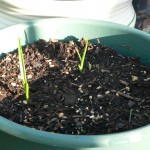
- I found a seed pod in the bulb garden last fall.
-
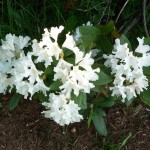
- Rhododendrons doing their thing.
-
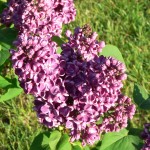
- The lilacs are finally out.
-

- Chinese lanterns I planted last year
-
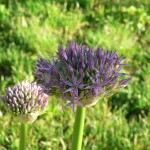
- I forget what these are, but they’re going to be huge
-

- These are my favorite of the flox
-

- I think the lilys have gone berserk
May 10, 2009
Wollyburble Challenge: Airplane food
Long-time reader Prunella Farquar suggests, and not for the first time, the topic of ‘Airplane food’. Her continued interest in this topic suggests that there may be cosmic significance to this topic. And I am highly suggestible.
= = = = =
Captain Qirm strode into his staff room holding a sealed envelope emblazoned with a deep red “Most Secret” label. His hastily-assembled executive officers immediately ceased their conversations and turned their attention to him.
“At ease. I just returned from an emergency meeting with Admiral Drymn,” Qirm began. “I can’t tell you all the details yet, but here is what you need to know right now. Two hours ago long-range EM sensors detected what appears to be the orbital bombardment of a small planet four hundred light years from here, in sector 5530. From the signature of the weapons, it looks like an attack by the Bigbellies.”
“As you know, sector 5530 is far beyond our frontier in that quadrant. It’s completely unexplored space. We have no idea why the Bigbellies would attack this planet. We’re being sent to sector 5530 to find out. We’re the closest unit. I want the ship battle-ready and prepared for a jump to megahypersupertrans warp in two hours.”
“If this was detected from beyond the frontier, via EM, then that must mean that the attack took place nearly four hundred years ago. So why the rush? Would it be more prudent to wait for reinforcements before jumping that far into an uncharted sector where there might be Bigbellies?” asked the tactical officer.
“I can’t tell you the reason, but headquarters believes that there is something very important about this attack. That’s why we leave immediately. But we won’t be alone for long. Five battle groups from the Glorb system, commanded by Admiral Drymn himself, will join us as soon as possible,” the Captain answered.
“The Glorbians will be able to reach 5530 in just a little over three weeks,” remarked the navigation officer, performing a quick bit of arithmetic in her head. “Their ships are very fast, and their refractory period between jumps is minimal. They’ll only be a few days behind us.”
“No,” the Captain responded. “That’s the bad news. They’ll be at least three weeks behind us.” Puzzled looks were exchanged around the table. “This mission has top priority, and I know it’s going to be hard on everyone, but we’re making this trip in one jump. The Admiral was clear on this. We need the answers with utmost speed. At 17:00 I want a jump plotted that will take us within three parsecs of the planet, assuming there’s anything left of it. The orbital calculations are already downloaded to your nav systems. Put us on the other side of its star. At 17:15 we’ll jump.”
“We’ll be in warp for at least thirty-six consecutive hours, sir,” commented the navigator.
“Then we better make sure everyone has a good meal before we leave,” growled the XO. “We’re damn sure not going to eat in warp. You know what happens to food during warp.”
The Captain nodded. “You all know what to do. Tell the crew this is important. This is one of the longest jumps ever made, but it could save a lot of lives. I’ll brief you on the details of the mission during the trip. Dismissed.”
= = = = =
Captain Qirm breathed a sigh of relief when Admiral Drymn’s battle groups winked into existence in formation around his ship. In a matter of minutes, Qirm was standing in front of the Admiral to give his report.
“Captain, I expect that your crew deserves commendations for their brave and arduous journey. The paperwork can wait, but for now, they can get some sleep and let the Glorbians take over. Now, tell me what you’ve learned.”
“As we surmised, the planet was inhabited before the attack. The inhabitants were unusual–a species we haven’t seen anywhere else. We haven’t been able to learn much about them, and what we have learned just raises more questions.”
“Tell me what you know. What happened here?”
“The planet was attacked by orbital bombardment. Almost certainly by Bigbelly weapons–even though the impact craters are four hundred years old, they’re an exact match for what we’ve seen from more recent attacks. The planet was wiped clean, virtually sterilized. There was no ground invasion, from what we can tell. No Bigbelly technology left behind on the surface, in any case. They bombarded the planet and then left. Why don’t know why. There is little of strategic or economic value here.”
“Did the inhabitants put up a fight?”
“That’s less certain. There are traces of unnatural background radioactivity, and the ozone layer has been removed from most of the atmosphere. We also found traces of chlorofluorocarbons, benzene, and complex aromatic polymers. Lots of them, actually. This suggests that they had some sort of poison-based ground defense. But they probably never had a chance to use it.”
“Good lord. Not even the Bigbellies are savage enough to use hydrocarbon-based or fission weapons. Not even them.”
“There’s something more. And you need to understand that this is much less certain. We’re piecing together data from a planet that was reduced to little more than a cinder hundreds of years ago. We have restored some of their data archives, but the information seems too strange to be true.”
“Noted. Now tell me what you’ve found.”
“Admiral, most of the inhabitants of this planet were peaceful species similar to those found on our own worlds. But not all of them. The dominant species–which we have not identified–genetically engineered a giant bipedal fighting creature that they used to fight their wars. These creatures were extremely belligerent and stood, in some cases, nearly two meters tall.”
“Two meters? Did I hear you correctly?”
“Yes. It would take our largest freighter just to carry the fossilized remains of one of them back to Eqir for study. And there were billions of them on this planet. Literally billions.”
“It boggles the mind.”
“And there’s more, Admiral. They were preparing some sort of transportation vessel for these creatures. I’ve seen the schematics, and the scale is hard to believe. They were capable of transporting hundreds of these monsters, along with their equipment. Hundreds. And they had unmistakable wings and fins. These weren’t just space ships. These were designed to travel within an atmosphere.”
“Landing craft.”
“That’s our guess. They called them ‘airplanes’. These vessels could transport hundreds of these creatures and then land, almost without warning, on the surface of a planet.”
“I can see why the Bigbellies might have considered them a threat.”
“There’s one other thing, and this is the strangest yet. But the evidence, even though it’s difficult to believe, is hard to refute. These vessels were equipped with mechanisms that allowed their passengers to consume food while traveling at top speed.”
“Hard to believe, indeed. How did they do it?”
“We don’t understand the technology. But we believe it’s true. They didn’t have to stop to eat. That’s the important thing. They had food on the airplanes. They could feed without stopping.”
“So they could enter warp, stay there as long as it took to reach any location in the galaxy, or perhaps beyond, pop out just above the atmosphere of an inhabited planet, and their monstrous shock troops could be on the ground moments later.”
The Admiral shook his head and paused.
“Just between the two of us, I think the Bigbellies did us a favor here. Airplane food. The ultimate tactical advantage. Ingenious, but inhuman.”
The meta-entry
There are a few things that everyone should keep in mind when reading my blog. The most important of these is that most of the entries are not autobiographical, and even those that do have an element of autobiography almost always have a much larger element of fiction.
For example, two recent entries got a few private comments that I feel deserve some clarification. First, the ‘On Golden Pond’ entry was inspired by a friend of mine who is thinking of moving to California. The rest is just a daydream. It’s a long and complicated daydream, and I’ve only started recording it, but there are no plans per se. On the other hand, I think it would be fun, and if she decides to drive her car, who knows? Maybe I’ll tag along. I’ll write the story first, and then, if it amuses Fate, perhaps I’ll actually take the trip.
Second, I don’t know how to play bridge, and I don’t even like to play cards, and I didn’t have anyone particular in mind when I created the characters–it’s not about you or anyone you know–and my knowledge of the game comes primarily from Wikipedia and Hoyles. As a result, the ‘Evening with friends’ entry changed a few times as I got feedback from my more bridge-savvy readers.
This entry is an exception. This entry is 100% real. Its matching entry, ‘What goes around’, is 100% fiction.
I tried an experiment yesterday. I hope you’ll find it interesting to read about.
In my day job, new ideas are a dime a dozen, but the effort required to turn an idea into reality is usually enormous. As a result, very few ideas are ever turned into anything concrete, or even written down. I suppose that it is the same way in every creative field, but it’s hard to appreciate from the outside. So I thought I would take a crack at writing something longer than a few paragraphs, just to see what it would take. The result was humbling.
Yesterday afternoon, as I washed the dishes from lunch, my mind wandered, as it often does, and in walked the idea for a story. I often get ideas like this, but most aren’t any good and I’ve forgotten them after a minute or two. This one kept my mind occupied for longer than it took to wipe down the stove, so I began to think that it might have legs.
Having no other major obligations for the day, I decided to spend my spare time trying to put it down on paper. It was a very educational experience.
- It took much more time than I anticipated.
- It took many more words than I anticipated.
- Dialog just goes on and on. It’s quicker to leave it out. Summarizing conversations is a real time-saver.
- My characters often say things that take the conversation off-script. This is annoying, but if I don’t let them, they sound even more like soulless automata.
- Many of the details of the story changed significantly between conception and execution. It was like writing down a dream; the more I thought about it, the fuzzier it got. The connective tissue tended to warp the story a bit.
The story originally had a happy ending, but I didn’t have time to get to it. When I was about one quarter of the way through story, I realized that the story needed to be half as long, and therefore a new ending was required. This happened before Joe even had a chance to say his first word to Mary, so you can imagine what an impact this had. Bad endings and nastiness are apparently quicker and easier to write. Happy endings are complicated, while unpleasant endings are easy. It’s much less work to let the heros die at the hands of the villian than it is to describe their dramatic rescue and return at the head of an avenging army, so to speak. The current ending is unsatisfactory.
After about six hours, I decided that I had used up my time budget and stopped in mid-dialog.
I present the story in its unedited form (sans even the mercy of a spell-check), in the hope that at some point I’ll be able to go back, clean it up, remove the terrible negative ending, add the happy ending, insert all the stuff carefully foreshadowed at the beginning, and you can enjoy the final product. In the meanwhile, you can see how the story devolved. It starts out playfully, with carefully structured narrative paragraphs setting the tone. By the end, however, it’s probably obvious that I’m watching the clock, the light-heartedness is gone, and it’s nothing but dialog, dialog, dialog.
In summary, I now have a new-found appreciation for how incredibly hard it is to write even a simple short story, and a conviction that I need practice before I make an attempt at anything more complicated.
Maybe Madoka will lend a hand.
What goes around
It was a beautiful afternoon in May, and the campus was at the most glorious point in its delightful transition from the bleak barren wasteland of Spring recess, immediately before senior theses were due, and the lush vegetation characteristic of the grounds and students during Summer School.
Having nothing better to do, Professor Joe Biggs decided to take a stroll across the campus. On the slim but plausible chance that his amiable peer, Professor Mary Gooly, might be on campus as well, his apparently aimless wanderings brought him, as if by chance, to the neighborhood of the art building. To say that Joe and Mary were an item would be to overstate the case, but since the previous weekend, when they had met at a dinner party hosted by a common friend and shared a pleasant evening of conversation, bridge, and Wii, Joe had felt that there was a certain spark. Telephone numbers had been exchanged, email had been swapped, names googled, and discrete inquiries made. Joe knew that Mary was single, and, bucking the stereotype for her department, straight and tended to have long-term monogamous relationships.
Joe realized that his relationship with Mary had potential when he found himself imagining how he was going to explain to his family that he was involved with a woman with a notorious reputation for leading no-trump on hopelessly weak hands, but he felt confident that they would come to respect and eventually love her for her many other virtues.
The landscaping of the grounds in this area of campus was different than the history quadrangle, where Joe spent most of his time, and both the flora and fauna were considerably more colorful. As Joe approached the steps at the front of the art building, his eyes were drawn to a spiky-haired undergraduate of indeterminate gender and unnameable garb who was consulting a poster that had been taped to the door. The poster advertised the opening of an installation of the work of the students about to graduate from the department, and Joe was mildly relieved to see that the exhibit was open. This gave him a reasonable excuse to go inside the building. Perhaps he would be lucky, and Mary would be at the exhibit. After a quick calculation, he determined that his story was quite plausible, and would not sound entirely creepy. There were a number of other people walking through the doors, most likely on their way to the exhibit, so this was clearly something an ordinary person would do. Besides, he honestly enjoyed art, and some of the students were gifted artists, and so Mary’s presence or absence was really just a red herring. With a clear conscience, Joe ascended the stairs and entered the building.
The exhibit was interesting, but few of the works made much impression on Joe. Although he was the first to confess that his knowledge of art was, at best, shallow and unschooled, he knew what he liked. None of this work spoke to him.
As he neared the end of circuit, one painting caught his eye. It was simply a still life–a pencil drawing of three pears in a bowl–but it was done in a manner that appeared almost photographic in the realism and level of detail. Joe had never been able to draw anything more complicated than a smiley face, and it amazed him that someone could capture and express such detail. Even more interestingly, he knew that most of the detail was actually being supplied by his own mind; the image was constructed of stark black lines on a flat white surface, yet somehow he was able to interpolate, between these extremes, an image of fruit. He sincerely wished, as he had many times in the past, that he had the gift of being able to draw or paint.
Joe noticed that the name of the student artist was the same as the name of a student he had had in one of his classes in the previous semester. He wondered if it could it be the same Alice. It seemed likely; how many Alice Barnchesters could there be?
She had been a good student, but not exceptional, except in terms of her attendance at his office hours. After her first few visits, Joe was not sure where the earnest curiosity ended and the brown-nosing began, and by mid-term he was beginning to wonder if it would save a lot of his time if he simply gave her the answers to the homework assignments rather than endure her endless questions and requests for help. Although he was tempted more than once to remind her that he was not her personal tutor, and that many of the questions she was asking could be answered by a small amount of diligence, a library card, and a network connection, he never succumbed to that temptation. Instead, he succumbed to the temptation of permitting her to continue coming to his office hours and asking more detailed questions than appropriate, because the alternative was to resign himself to the tedium of an empty, silent office punctuated only by the the occasional unscheduled visit from someone complaining about how his or her test was graded. Joe remembered Alice with a mixture of fondness tempered with mild annoyance, and idly wondered what she was planning to do after graduation.
Joe was unfamiliar with the art building, and after he left the exhibit he found himself walking down a hall lined with small studios with large glass doors. One was occupied by someone drawing a portrait of a young man sitting on a chair and reading a book. As Joe passed, the artist came into view from behind her easel, and he recognized Alice. Without thinking about it he rapped on the glass door. Alice looked up as her model turned around, and Joe recognized Andrew, one the other students who had been in his class with Alice. Alice recognized Joe, smiled, and waved for him to come in. Andrew removed his earbuds.
“I was just at the exhibit, and I saw your still life. I thought it was remarkable. You really captured the, well, I don’t know what you would call it. The essence of the fruit. It looked very real. It impressed me, anyway.”
“Thank you.” Alice smiled and looked down.
Joe continued. “I don’t know how to draw anything myself, and you are obviously have a gift, or a knack, or whatever it would be called, and so I was wondering, if you don’t mind, if I could watch you draw for a few moments. But only if you don’t mind. I don’t want to break your concentration or get in the way or anything like that.”
“It’s OK. You can watch for as long as you like. I’m afraid it’s not very interesting to just watch, however. It might be more fun if you tried doing it, too.”
“No, I’d just like to watch for a minute. Is it OK with you, Andrew? I don’t want to get in the way.”
“It’s OK, I guess. It’s cool, as long as Alice says it’s OK.” Andrew shrugged and put his earbuds back in.
Joe sat on a folding chair at the back at the back of the studio, several feet behind Alice and a few feet to the side, where he could watch her draw on the paper and look at Andrew at the same. The drawing looked like it was nearly finished, but Alice would occasionally erase a small part of the drawing or intentionally smear other parts with her fingers, and then start on that area again. Joe was captivated. He watched as an impossibly small number of lines, seemingly placed at random, suddenly knitted together to form the image of a mans hands. A bit of shading, and they were just as suddenly Andrews hands.
“That’s amazing, how you drew his hands like that,” Joe said.
Alice continued drawing, but started to describe what she was doing. “It’s not hard. I’m not sure I can explain it, at least as well as Professor Gooly can, in technical terms, but it’s sort of half intuition and half practice.”
The mention of Mary engaged Joes attention. Joe decided it made sense to pay attention, if this was something that Mary found interesting or important. Even if he couldn’t draw, at least he need not sound completely ignorant.
Alice continued describing the process, although very little of it made much sense to Joe, who soon began to wonder whether he lacked some particular mental ability crucial to the understanding of free drawing, or whether he was suffering because another part of his brain was overdeveloped. Joe had always prided himself on having a fully functional and unusually sensitive bullshit detector.
“You know,” said Alice, “you would probably learn a lot more by actually trying to draw something than by listening to me talk. Why don’t you try drawing something right now?”
Joe was was suddenly very self-conscious. He did not want to draw in front Alice or Andrew. “I really can’t draw. I’m not being modest–I’m really terrible. It’s probably pointless for me to try and it would certainly be a waste of your time to try to teach me.”
“After all of your time I took in your office hours, it’s the least I can do to take a few minutes to tell you some pointers. Go ahead. There is an extra easel leaning against the wall, with paper already tacked on. Just move it over here, and try.”
There was a certain sweetness in her voice that made Joe overcome his embarrassment. He set up the easel and Alice handed him a pencil that looked to Joe like a fat graphite crayon.
“What should I draw? I don’t think I’m ready to draw a person.”
“Well, you can start by drawing simple forms–spheres, cones, cubes, things like that. Try to make them look real, with shading. You can make a shadow by rubbing the paper with your finger like this.”
“Maybe I will try a sphere.” Joe began to draw.
Joe began to draw. He tried to draw circles, but the results were not round. Sometimes he had problems getting the start and the end of his circles to meet, but by being slow and methodical, his circles gradually evolved from potatoes to ovals to eggs.
As he was drawing, Alice watched over his shoulder for a moment, but made no comment. Andrew looked bored and restless. Noting Andrews discontent, Alice walked over to his chair, gently pulled out one of his ear buds, leaned over and whispered a few words into his ear, and then lightly kissed him on the top of his head. Andrew popped the ear bud back in, nodded once, and smiled.
Alice returned to her work, only glancing at Joe from time to time. Joe felt that he was making great improvement, but was painfully aware that all improvement is relative. His circles were barely round, and as he tried to shade them, the results were very different from what he expected, and never seemed to be the same twice. He soon decided to simply try to reproduce the same shading more than once, in order to feel that he had any control over it at all. After several minutes he felt he had made some progress, and returned to the task of shading spheres.
Before he realized it, at least fifteen minutes had gone by. He stepped back to inspect his work. The paper was tiled with four rows of irregularly space and sized circles of varying roundness and shading. None of them looked like spheres. None of them looked like a drawing of anything in particular.
Joe thought it had been fun to try, and although he felt a slight sense of accomplishment about keeping the smeared graphite approximately where he had intended, he didn’t feel like he was making any real progress.
He put the pencil down on the easel and turned to thank Alice and tell him that he needed to go. He was surprised to see her standing immediately behind him, looking past him, at his paper.
“I thought you said you couldn’t draw,” she said. “You’re too modest. You’re great! Andrew, what do you think?”
“They’re fantastic! Practically leaping off the page! From here it looks like someone glued ping-pong balls to the paper–I can’t believe it’s really flat. I wouldn’t believe it myself, if I hadn’t watched you do it.”
“Do you really think so?,” asked Joe. He was puzzled. He turned back to look at his paper again.
A small movement at the bottom of the easel caught his eye. A small fish-eyed mirror had been glued to the bottom of the frame. Joe remembered why they were there–because the walls of the studio were mostly glass, and many of the students who worked there late at night got nervous about whether someone was looking in on them, especially after there had been reports of strange men who had an unhealthy interest in some of the nude models employed by the painting classes.
Joe glanced at the mirror. He saw Andrew flash a thumbs-up at Alice and saw Alice wave back, motioning his hand down. She had a broad smile on her face.
Joe turned to face Alice. Her face was earnest. Andrew looked enthusiastic.
“You have a gift, Professor,” said Andrew.
“I don’t see it,” said Andrew.
“It’s not perfect, but it’s awfully good,” Alice commented. And this is the first time you’ve ever tried this? I’d say that is remarkable. With a little more practice, who knows?”
Joe turned to the easel once more. In the mirror, he saw Alice motioning for Andrew to be quiet. Andrew cleared his throat.
“Which one do you think is best?” he asked.
“There are several that are good, but in different ways,” Alice answered. “I like the last two you did best.”
“I was so engrossed that I didn’t even notice that you were watching me,” Joe remarked. “These two?” he asked, turning again towards Alice. “I can hardly tell them apart. None of them look that good to me.”
“Maybe your problem isn’t that you can’t draw,” said Alice. “Maybe your problem is that you can’t recognize it when you draw well.”
“I recognize it when other people draw well. I think I can tell a good drawing from a bad drawing. Do you really think they’re that good.”
“Well, they’re a beginning. But definite signs of a gift. You’ll have to cultivate it. Nurture it. And practice a lot. But eventually you’re going to be fantastic. In fact, I think in a few weeks you could have something to submit to the faculty art magazine.”
This is complete bullshit, Joe thought to himself. But looking past Alice, he saw Mary Gooly walk by.
“Thank you very much for the lesson, Alice, and the kind words, Andrew, but I just realized that I’m very late for something,” Joe said, and quickly left the studio, in pursuit of Mary.
“Mary! Hello!,” Joe said, seeing Mary ahead of him in the hall.
“What brings you here? Doing a little drawing today?” Mary asked, looking at Joes hands, which were covered in graphite. “I thought I saw you in the studio with Alice and Andrew when I walked by, but I thought maybe I was imagining things. Are you helping them?”
“No, that’s not it at all,” explained Joe, quickly outlining the course of events that had led to this moment. “I came to see the senior projects exhibit, and when I was leaving, I ran into Alice, and stayed to watch her draw for a few minutes. I think she’s really very good.”
“How do you know Alice?”
“She was in one of my classes. So was her model, Andrew. Last semester.”
Mary looked closely at Joes face. “Is that it?”
“That’s how I know her. That’s it. But I’m intrigued by the way that you asked. Is there something about Alice that I don’t know?”
“Is it normal in the history department for professors to just drop by and socialize with their students?”
“No, not particularly, but since she used to come to office hours quite a bit, I guess a certain familiarity grew between us, so I didn’t feel uncomfortable about it. Nothing improper, in my opinion.”
“You were with an undergraduate in a closed studio, in an area of the building that doesn’t see a lot of traffic on the weekends,” Mary hissed.
“I was in a studio with a glass door, with a student and her boyfriend, and people were just walking right by. For example, you. Are you accusing me of something? If you thought there was something going on, why didn’t you poke your head in and check?” Joe struggled to keep his voice from rising. He did not see why this conversation was becoming heated.
Mary took a deep breath and let it out slowly. Her shoulders relaxed. She continued in a lowered “I’m not accusing you of anything. I don’t think you’re that kind of person. Not that stupid. But Alice–she’s something to worry about. I’m worried about you.”
“How so?”
Mary looked in both directions to check that the hall was unoccupied. “Do you remember Jenkins, who left last year to take a post at UC Davis? Do you known why he left, just one year before his tenure decision?”
“No, I don’t know anything. We don’t really know what goes on in other departments. We don’t spread rumors. Historians hate rumors.”
“Well, there were rumors in our department. Rumors that he was having an affair with an undergraduate. With Alice.”
“That’s awful for her. Why wasn’t he fired? He shouldn’t be teaching at a University, if he’s that sort of person.”
“He’s not. He didn’t do it. I don’t know the details of what happened, but I know Jenkins. He wouldn’t ever have done this. I’ve known him for years and there’s no way the rumors are true. No way. But once rumors get started, the damage is done. Nobody ever remembers whether you got exonerated, they just remember that you were accused.”
“OK, that’s awful for him. But still, why the concern?”
“I don’t want the same thing happening to you.”
“I’m not involved with Alice. Not in any way.”
“I know. But it only matters what people think. And what rumors people start. She’s scary. I think she started the rumors to get rid of Jenkins.”
“That’s a strong accusation.”
“I’m her advisor. The one thing she’s good at is drawing. Academically, she’s not good at much else, but she manages to pass all of her classes, one way or the other. She works the system. It’s OK; lots of students here work the system. But last semester, she was having real trouble in Jenkins class. She wanted to transfer out, but it’s a required course not offered this semester, so she needed it to graduate. I don’t know what happened, but here’s my guess. She tried to get Jenkins to help her, one way or the other. He refused. She filed harassment charges with the Dean.”
“OK, look. She’s not in any of my classes. I probably won’t ever see her again. After this conversation, I’ll make a point of it. There’s nothing going on, and frankly, I don’t even like her right now. In fact, I’m pretty annoyed.”
“Oh?”
Joe told about watching Alice draw, and, with some embarrassment, about his futile attempts to draw spheres, followed by Alice and Andrews sarcasm and attempts to set him up for future humiliation.
“Are you sure they were joking?”
“I’m sure. I can’t draw. I stink. They were laughing at me.”
“And you’re sure she was drawing a portrait of Andrew, reading a book?”
“Yes. It would be pretty hard to miss that.”
“Well, that’s interesting. That’s her final assignment, and she’s only supposed to spend three hours on it. By my count, she’s already spent far longer, and is still working on it.”
“Final assignment? For what course?”
“Drawing and critiquing. The final assignment is to draw something to spec, and to critique a drawing submitted by another member of the class.”
“It sounds harsh, having to hear people tear apart your work.”
“It’s not like that. The critique is supposed to focus on the positive elements. No drawing is perfect–there’s always something bad to say. That’s too easy. The skill I try to teach is to find what is good about it. There’s always something good to say.”
“Not with my drawings. Unless you’re teaching people how to bullshit, they’re not going to find anything good to say.”
“Are they really that bad?”
“Horrible. I’m dying inside, just thinking about them.”
“Hmmm… I have a nasty idea. Do you think you can tolerate seeing Alice one more time?”
“What do you have in mind? Am I going to get into trouble?”
Mary quickly explained her idea. Joe added a few modifications. They smiled at each other.
“This will take careful timing,” said Joe.
“Trust me.”
“They might already be gone.”
“Nothing ventured, nothing gained.”
Without answering, Joe turned on his heel and retraced his steps to the studio where Alice and Andrew had been working. They were still there, and Alice was still drawing. Joe rapped on the glass for a second time, and Alice waved him in.
“I was practically back to my car, when I realized that I have no idea where to get this kind of pencil,” he explained, standing in the doorway. “Can I have the one I was using? Or can I at least write down the brand name and number, so I can buy my own? I really want to do more drawing. Thanks to your encouragement, I think I’m really getting the hang of it.”
Joe hoped he wasn’t overplaying his part. Acting had never been one of his skills.
Leaving the studio door open, and without waiting for Alice’s response, Joe walked to the back of the studio and picked up the pencil from the easel. Andrew appeared to be rolling his eyes.
Mary appeared at the open door and quickly entered.
“Hello, Alice and Andrew. And hello, Joe! Alice I’m surprised to see you working so late. Is your final assignment finished? Haven’t you used up all of your time?”
“I’m working on something else. A graduation present for Andrew. My final drawing is finished and I’ll bring it tomorrow morning,” Alice lied without hesitation.
“Excellent. I look forward to seeing it. If it’s half as good as this drawing of Andrew reading, you will receive high marks. It’s too bad this isn’t your final project. It’s a wonderful subject.”
Alice bit her lip but said nothing. Mary paid no attention to her silence and continued talking, turning towards Joe.
“And Joe, I’m quite surprised to see you here at all! What brings you here?”
“Alice was showing me how to draw shaded objects. She said I have a gift. I drew a bunch of shaded spheres. Andrew said that he thinks they look like they’re leaping off the page. Anyway, long story short, I just came back to get a pencil.”
“Alice, are they really that good?”
Alice looked at Joe, and then back at Mary. “I thought so.”
“Can I see them?”
“Joe has them, I think. They’re not here.” The easel was empty.
“Joe, do you have them?”
“I think I left them here somewhere. They’re probably somewhere in the stack over here, by the garbage. In any case, I know I left them here, so they’re somewhere in the room.”
“Good. Listen, I have to go. But I have an idea. Alice, I want you to critique Joes spheres tomorrow morning at class. If they’re really that good, it will be a pleasure to hear your insights.” Mary turned and walked quickly through the door and down the hall.
“Ah, found them,” said Joe, pulling his work of art from the garbage. “I don’t need them. I think I’ve learned the lesson. You can have them. I hope everyone likes them tomorrow. And congratulations on graduating.”
Joe followed Mary out the studio and down the hall. He caught up to her on the steps.
“I was wondering, are you busy tomorrow night? Would you like to get together for dinner or something?”
“You want to know what happens.”
“Partly. But I also want to get to know you better.”
Mary smiled. “OK. I’ll call you tomorrow. We’ll work something out.”
– – – –
Joe didn’t ask until the waiter brought the coffee.
“I’m curious about how Alice’s presentation went today.”
“I’m curious about why you didn’t ask earlier.”
“I wanted to show that I was more interested in you than Alice.”
“Are you that kind of a schemer?”
“You’re asking me? This thing with Alice was your idea.”
“Touche.”
“You would have figured it out anyway.”
“Of course. I just wanted to hear you say it.”
“OK, so what did happen?”
“First, she presented your spheres, and did a critique.”
“How did they look? Were there any survivors?”
“They looked fantastic. They really did look like they were three dimensional, like they were sticking out of the page.”
“No.”
“Yes!”
“They weren’t mine.”
“No, of course not. She probably stayed up all night drawing her own spheres. They looked like her style, and they were magnificent. Her best work. It’s too bad she couldn’t get a grade for your work.”
“I didn’t think she’d do that. I thought she’d confess.”
“I was a little bit surprised too. But not very surprised. You don’t know her as well as I do.”
“But what about her drawing? What did she present? If she stayed up all night doing the spheres, and she couldn’t do Andrew, what did she do?”
“You’re going to laugh.”
“I’m dying to know.”
“A quick hard pencil sketch of a man and woman making love. No shading, very few lines. A remarkable work of minimalism. Unlike anything I’ve taught her. Better than I could have taught her. Could go straight into a museum.”
“Wow. Sounds amazing. What happened to it?”
“All the students own their artwork. She took it away at the end of class. She has it. If you want to see it, you’ll need to ask her.”
“That’s not going to happen.”
Mary took a sip of her coffee and looked at Joe. She held his gaze until he cocked his head to one side, raising his eyebrows quizically. “There’s something else, isn’t there,” he said.
“I want you to know something first. Miles, your squash partner, is an old friend of mine. I talked to him earlier this afternoon.”
Joe waited patiently. Mary wasn’t finished.
“He knows something about you that I didn’t. I apologize for asking him. I should have trusted you. I trust you now. You need to know that first.”
“I don’t know Miles very well. We just play squash together a few times a month. I can’t imagine what he told you.”
“He told me that you have an appendectomy scar. A big one. From back when they had to slice people open to get it out.”
“I was a teenager. It was a big deal back then. I’ve got staple marks. They’re not pretty. But I am still baffled about where this is going. What does my appendectomy have to do with anything?”
“The women in the drawing was Alice. The man in the drawing had your face. But no scar.”
“I am at a loss for words. No, I have words. I’m going to have nightmares about this.”
May 9, 2009
The wrath of continuity
It’s hard to summon up much remorse about revealing some of the plot twists in a popular movie that was released more than twenty-five years ago, but just in case, I suppose it is only fair to my readers to warn them. If you haven’t seen ‘Star Trek II: The Wrath of Khan” and plan to see it some day, then please stop reading now. The same applies if you saw it, but forgot most of it (time does have its way with us) and plan to refresh your memory at some future point.
From what I’ve read in reviews of the latest Star Trek movie (simply titled ‘Star Trek’) I advise you to postpone viewing it as well, at least until after seeing ‘The Wrath of Khan’ because apparently some of the twists are given away there as well. I haven’t seen the new movie yet, but I am already prepared to be slightly disappointed by this one aspect.
OK, if you’re still reading, you can’t say that you weren’t warned.
If you’re a Trek fan, then I’m sure you’ll be in a good position to correct my rapidly fading memory of a movie I haven’t seen since clogs were fashionable for men, but I hope you will not feel any obligation to become offended at my unfamiliarity with the canon. I’m certain that details such as the colors of the uniforms and whatnot are all very important in some larger context, but maybe not for the purposes of this discussion.
The movie opens on the familiar bridge of the starship Enterprise, but with an unfamiliar face in the captains chair–a young woman. Most of the other members of the bridge crew are the faces familiar to any Star Trek viewer. The Enterprise is on patrol near the border of a disputed area (or the neutral zone? The forbidden zone? Whatever). They hear a distress call from a civilian vessel, the Kobayashi Maru (yes, I had to look that up) that has strayed off course with engine troubles into the disputed area. There appear to be no enemy ships nearby, so the captain (commander? again, I have no idea) takes a calculated risk and orders the Enterprise into the disputed area to rescue the civilian vessel. As they approach, enemy warships appear, destroy the civilian vessel, and begin to attack the Enterprise, which takes immediate heavy damage. It’s an ambush. The captain orders the Enterprise to flee, but enemies have cut off the escape route and propulsion is failing. Her weapons are inoperable. The captain attempts to hail the enemy to offer surrender. In response, the enemy fires another salvo, targeting the bridge, killing all of the bridge crew except the captain. The ship is defenseless, surrounded by enemies, and the captain is alone. She does not appear pleased with her circumstances. She is at a loss.
At which point it is revealed that this is only a training exercise. It has all taken place in a simulator. The trainee-captain is baffled. She doesn’t see any way to have saved the Kobayashi Maru. She asks Admiral Kirk (formerly captain of the Enterprise) about it, and he tells her that she didn’t make any bad decisions, but that wasn’t the point. The civilian vessel is doomed, no matter what she does, and the Enterprise is doomed the moment it crosses into the disputed area, but of course there is no way for her to have known that ahead of time. The purpose of the exercise is to see how a prospective officer deals with a no-win situation; to see how he or she acts when faced with the loss of his or her ship, crew, and life. It’s a situation that any commander might face.
But then she learns from someone else that, as a cadet, Kirk did beat this exercise. In fact, he’s the only person to have ever done so. She wants to know how.
As she learns near the end of the movie, Kirk beat the exercise by cheating. He broke into the simulator before the test and changed the parameters so that there was a way to win. He never accepted that there was really such a thing as a no-win scenario, and therefore refused to be tested on one. No additional details are given.
That’s the sort of level of detail I like. I don’t need to know any more, and I usually don’t want to. The interesting thing, to me, is the motivation of why people do things, not the minutae of what they did. This is why I usually like, in terms of contemporary entertainment, either the book or the movie, but not usually both, because the standard treatment seems to be that films focus more on spectacle while books focus more on plot and character. As an example, consider the fraction of running time dedicated to battles in the ‘Lord of the Rings’ movies compared to the fraction of the pages used to describe those battles in the books.
The new movie, according to reviews, shows the whole Kobayashi Maru exercise and how Kirk beat it. Do I really want to know? Like the story of Sir Gregory Parsloe-Parsloe and the prawns, it may be that some things are better left to the imagination.
But of course I’ll go see it anyway… for the spectacle, if nothing else.
May 8, 2009
Wollyburble Challenge: An evening with friends
Long-suffering reader Kate Ainsworth asks: “Is arrogance the enemy of empathy? Can they live together?”
– – – – –
After the last card was dealt, Arrogance picked up his hand, fanned it quickly, and immediately closed it again.
“It’s your bid, dear,” said his partner, Empathy.
“Five spades,” growled Arrogance.
To his left, Insouciance raised her eyebrows. “Isn’t that a very high opening bid?,” she asked, and then turned to look for an answer from Empathy.
“Not that high. If you have the cards. If you don’t have the cards, then it’s a ridiculous bid,” noted Arrogance.
“Dear, don’t forget that this is the first time Insouciance has played bridge,” said Empathy, slightly lowering her forehead.
“Yes, of course it is,” responded Arrogance. “So here’s what you should do. You should bid something higher. Six of something. Whatever looks best to you. And then that means that when it’s my turn to call again, I can double. If you don’t bid something, and Empathy and Apathy pass, then the contract is five spades. You know I think I can do it. If you out-bid me, then you’ll have to make the contract. What is your response?”
Insouciance looked over her cards and bit her lip. “Pass,” she mumbled after several moments of consideration.
“This isn’t the right way to teach the game,” said Empathy directly to Arrogance. She turned towards Insouciance and continued. “Usually the first round of bids are used only as a way for the partners to exchange information, to communicate, about the strengths or weaknesses of their hands. For example, as I was explaining a moment ago, an opening bid of ‘one heart’ typically means that the caller wants his partner to know that he or she has a hand that is strong in hearts. If it is particularly strong, he or she might increase the bid on the next round.” She turned to Apathy and continued. “It does take some time to learn how it works, bu it’s not hard, and eventually it becomes almost intuitive.”
“Bid, please,” muttered Arrogance impatiently. Empathy ignored him.
“Perhaps it would be more educational–and fun–to deal a few hands and just practice bidding on them,” suggested Empathy.
“Whatever,” opined Apathy. “I’m just here for the conversation. I don’t really care about this game. It has too many rules. It all seems arbitrary.”
“Maybe we should just play Hearts, then?,” suggested Arrogance. “Fewer rules to remember. And less thought. It’s mostly luck. Or maybe Old Maid? Go Fish?”
Arrogance smiled at Apathy and took a sip of his coffee. Insouciance stared intently at her hand. Apathy began to mouth a word, but then hesitated.
“Will you look at the time? We really must be going,” said Empathy, breaking the silence. “We promised the sitter we’d be home by, ummm, nine forty-five,” she continued, after quickly consulting her watch.
“Yes. We do need to get going. I really lost track of the time. You know how it flies when you’re having fun, and all that,” gaily added Arrogance.
“I suppose,” muttered Apathy. “I’ve never really understood that expression.”
Insouciance put down her cards and smiled. “Thank you for teaching us how to play Bridge.”
“There’s more to learn. Much, much more. Maybe we can do this again soon?,” Arrogance replied.
“Certainly we must have you over next,” added Empathy. “But we don’t need to play cards. We don’t need to play anything at all. Maybe we can discuss books.”
Arrogance immediately perked up. “If one of you could explain the end of Gravity’s Rainbow to me, I’d certainly appreciate that. I’ve been stuck on that for years. The rest of the book makes perfect sense, but the last two hundred pages or so–whoosh! Right over my head! I think that’s why although it’s Pynchon’s most critically acclaimed book, it didn’t sell as many copies as, say, Vineland, which is much more appealing to a broader audience. It’s a much easier read. Have you read it?”
– – – – –
Empathy was silent for a few moments as they drove away. As they merged onto the highway, she began to speak in a measured tone.
“I don’t think the Winslows will be inviting us over for cards again any time soon.”
“That’s too bad. I was having fun.”
“Yes, you were having fun. But nobody else was having fun. You didn’t have to make a big deal about how bad they are at playing cards.”
“I like to win–what’s wrong with that? And I was winning, so I was having a good time. I don’t think I made a big deal about them being bad at cards.” Arrogance paused and then chuckled for a moment. “And boy, are they bad at cards! I’d only feel guilty if we were playing for money or something. We’d probably be driving their car home instead of our own. Or maybe we wouldn’t even be driving home at all–maybe we’d be kicking them out of their former house!”
“But you were mean. You were rude to our hosts. You made them feel stupid.”
“Well, maybe I made them feel bad at cards. Or maybe I helped them come to terms with their inability to play cards. That’s not the same thing as making them feel stupid.”
“It’s too easy for people to get those two things confused. You know how it is. When you insult part of a person, or point out a flaw in a person, it taints all of their feelings.”
“You’re a fine one to talk.”
“I beg your pardon?”
“At least I treat them as foes worthy of humiliation. You, all touchy-feely and understanding, treat them even worse.”
“I’m looking forward to hearing your reasoning. Do go on.”
“You accept their problems. You feel for them. You sympathize. You’re complacent. You want to see their point of view. Don’t you know how insulting that is?”
“No. I’m not getting it.”
“OK, let me try again. Insouciance stinks at bidding. She just doesn’t get it yet. You are OK with this; you understand her difficulty and you feel her pain. You make her feel like it’s OK. Don’t you think it’s condescending to tell someone that you understand why they’re terrible at something? Maybe a little indignation would be more helpful. Some incredulity. Don’t just try to understand their problem–focus on the solution! Don’t tell her it’s OK to suck at Bridge. Tell her she shouldn’t suck. Expect her to not suck. Reject suckage, it all its forms!”
“But I think you hurt their feelings.”
“Yes, maybe so. For the sake of argument, let’s say I did. But maybe they’ll get better at Bridge in order to avoid further pain. Maybe this will help them grow as people.”
“More likely they’ll just never invite us over again. And what good are your Bridge skills if you can’t get anyone to play with you more than once?”
“Look, when I’m better than someone else at something, I enjoy it. Of course I understand their feelings. If I didn’t understand their feelings, then I wouldn’t enjoy it so much. I don’t want to make them feel miserable, I just want to feel better than they feel. It’s part of the game.”
“But not everything is a game. Sometimes feelings are more important that winning.”
“Not to me. To me, everything is a game. Everything is about winning. I thought you, of all people, would understand that about me by now.”
Empathy looked out the window at the passing cars. She was silent for several minutes.
May 7, 2009
Danny on the porch
Danny wiped the dirt from his hands and started to work loose the soil trapped under his thumbnail. The sun was bright on the porch.
“Thanks for helping me thin and re-pot the morning glories,” said Madoka. “I didn’t know how many would come up, so I just put all the seeds in two pots.”
“I hope they survive,” commented Danny. “I don’t know if they do well being transplanted. I’ve heard that they don’t. I’ve never tried it. Still, you’ll probably get a better yield than I did.”
“What happened to your glories?”
“I started them very early indoors this year, and when I took them outside, almost all of them died in a few days. I think they couldn’t take the transition. Maybe I coddled them too much.”
A woman walked by along the sidewalk, nodding her head in rhythm with the private music playing on her iPod. Madoka reached for the broom and began sweeping the dirt that had fallen outside the pots.
“I also started some seeds in soil outside, and they did much better. I guess I’ve learned something.”
“That’s too bad,” sighed Madoka. “Your trellis looked so good last year, covered in flowers.”
“There’s still time. I can plant more. But no moonflowers this year. They don’t seem to like the climate. A huge vine, and exactly two flowers. I’d rather have a few hundred morning glories.”
Danny watched the neighbors clean out their garden for a moment. It wasn’t clear what they were trying to do, but their garden was an obvious success. Danny wondered what he could learn from them.
Madoka picked at the rose bush that was climbing the pillar at the corner of the porch. Danny wondered if the glories would climb up the rose. It might be a nice combination, if they didn’t kill each other.
A man wearing a Red Sox cap emerged from the house across the street, climbed into his car, started the stereo and then the engine, and drove away. The bump-bump-bump of the music faded as he turned the corner at the end of the block.
“Are you still thinking about California?”
“Yes,” Madoka answered without pause. “It could be very good for my career. The lab director there really wants me in his program.”
“It’s too bad you have to move around so much in your field. I’m lucky. I don’t expect I’ll ever have to move.”
“Well, it’s not just that. I want to make a new start. I’m not sure that Boston is a good place for me.”
Madoka paused for a moment.
“I also want to get away from Him. I don’t think he’ll follow me to California.”
Danny said nothing. There was nothing left to say about Him.
“When would you move?”
“I don’t know. The funding for the new project probably won’t be in place for a few months. And there’s some work I’m doing that I need to finish. Some time over the summer, or maybe early in the Fall.”
Madoka went into the house, filled a milk jug with water, and returned to the porch. Danny sat on the steps and listened to the wind softly rustle the last few dead leaves remaining from the previous autumn. Madoka slowly watered the pots until small rivulets of water began to emerge from the bottom of each pot and disappeared through the cracks in floorboards of the porch.
“I’m not looking forward to moving. I’ve never done a move like this. I have so much more stuff than last time I moved and this is so much farther. I guess I’ll sell the stuff I don’t like and just take the things I want to keep.”
“Things do accumulate, don’t they. When my wife and I moved into our first apartment, we moved all our stuff in the back of our car. By the time we moved out, we needed a professional mover and a big truck. And it just keeps getting worse. We never throw out anything big. We just get rid of the small stuff.”
“I guess I’ll need to hire movers.”
“It’s much easier. They pack so much more quickly than you can.”
“Why are they so fast?”
“Well, when I pack, I have a bad habit of looking at the things I’m packing and trying to decide if I want to keep each thing, or just letting my mind wander, reminiscing about how long I’ve had it, and the last time I looked at it, and things like that. It can take me an hour to pack a box of books, or all afternoon to pack the knick-knacks on my desk. The movers get it done in an instant. This stuff doesn’t mean anything to them. It’s not their stuff. They’re only thinking about how to get things into boxes. When we moved into our new house, they packed up the old apartment in a few hours. Everything.”
“Are they expensive?”
“It’s not cheap, but it’s worth it. Especially if you have other demands on your time. But you have to be careful, because they’re so mechanical about it that you need to watch over them sometimes.”
“What do you mean?”
“For example, if you don’t empty the garbage before they come, they’ll pack the garbage in a box. It won’t be fun opening that box a week later in California! And they’ll pack anything else that isn’t nailed down. We had to take the fireplace grate back to our old apartment–they’d packed it.
“Oh, I see. But I think moving is going to be expensive for a lot of other reasons. For example, what about my car? It isn’t worth much, so I can’t sell it for much, but when I get to California I’m going to need a car, so I’ll have to buy one.”
“Why don’t you just take it with you?”
“I don’t want to drive it the whole way.”
“You don’t need to. The movers can take it. They can put it right on the truck.”
“Really?” Madoka looked incredulous.
“Yes. When my parents moved to California, they put three cars on the truck. It was a big truck. It made things very easy for them. The movers packed up their house, and started on their way, while my parents hung out for a few days at friends houses, and then they flew out to California and got there about the same time as all their stuff.”
Madoka moved the pots slightly, to align them with the sun.
“I wonder how much it costs.”
“I don’t know. I’ve never moved a car. I’m sure you could just call a moving company and they’d give you an estimate.”
Madoka started to gather her hair into a ponytail, but then remembered that her new haircut made this impossible. Danny still found the new hair style unfamiliar. He didn’t know how long she’d had it. It was new to him.
“How long do you think it would take to drive?”
“Well, it’s about three thousand miles, and I don’t think most people can endure sitting in a car for more than about three hundred miles per day. So maybe ten days. Maybe more if you do some sight-seeing along the way. It would be a shame to just drive past everything without taking a look.”
“Yes, I’d want to stop. But then it would take forever.”
“I’ve heard it works much better if you have company. Then you can split the driving. One person can sleep while the other drives. You can cover a lot of ground that way. That’s how the movers do it. Truckers can cross the country in three days or less.”
“But I wouldn’t want to do that either. It would be fun to see America.”
Danny thought of Kerouac, Steinbeck, Clemens, Trollope, Kesey. Danny remembered how he had planned road trips in the past, but the plans had never worked out. Something had always come up.
“I’ve always wanted to drive across the country. I’ve even got a route figured out. I’ve planned it.”
Madoka smiled. “I think it would be a lot of fun. I’ve always wanted to do it too. I think a lot of people have. But I’ve never had the time.”
Danny looked at his watch. It was getting late. He had promised to be home in time for dinner.
“I’ve got to get going.”
“Thanks again for helping with the plants.”
“No problem. Oh, and if you’re really thinking about driving across the country, we should talk more.”
“Would you really want to do it?”
“I’ve always wanted to do it. But I’ll need to check with my wife.”
Madoka watched Danny climb into his car and drive away. The wheels in Danny’s head were already turning, and his mind was somewhere west of Omaha.
May 6, 2009
Wollyburble Challenge: Things that baffle me
Faithful reader Prunella Farquar suggested the following topic:
Things that there are perfectly reasonable explanations for…but that still don’t make sense in your mind. Why does water expand when frozen when everything else contracts? (Yeah, yeah, I know…hydogen bonds, but it just doesn’t seem right)
Airplanes should not be able to stay in the air, but even knowledge of pressure and air currents doesn’t convince me.
Nothing will convince me that helicoptors can fly!
I am fascinated by what baffles other people, and how they express their baffled state. For example, when Prunella writes that nothing will convince her that helicopters can fly, I know that this isn’t the truth. She has seen helicopters fly (and, for all I know, as actually ridden one during flight) and has successfully internalized the idea that helicopters actually can and do fly. What she really means is that she doesn’t understand how things can exist–especially things that have been created by humans themselves–that she is unable to understand.
This cognitive struggle isn’t unique to Prunella. In fact, I think it’s an unavoidable aspect of the human condition. It is one of the seeds of curiosity, the precursor (if not prerequisite) to all new intellectual creations. Deep in her heart, I believe that Prunella longs to hear a satisfactory explanation of how helicopters fly. She doesn’t want to be convinced, she wants to understand.
But what is unusual about Prunella is her recognition and acceptance of this aspect of her humanity. Far too many other people are content to settle comfortably into the cage of their ignorance, Prunella catalogs the contents of her intellectual prison and measures the dimensions of her confinement.
There are an amazing number of things that I simply don’t understand, and I’m not sure whether anyone else understands them either, or at least can provide an explanation that I could understand. Sometimes my ignorance annoys me, most often when I don’t understand things that I believe I should, and especially when I don’t understand things that other people do. In no particular order, here are a few things that I simply don’t understand:
- Sex. Why do some people have a preoccupation with inserting convex parts of their anatomy into the concavities of other people, and why do some people have a preoccupation with having their voids filled with the protrusions of others? And there are infinite additional variations, of course, many of which can’t easily be described with a straight face, but for the sake of this discussion, we’ll limit the definition of sex to pleasurable actions involving friction and genitalia. So, what’s the attraction? And what does it have to do with high heels and stockings? People say that the pleasure we derive from sex is necessary in order to ensure that sex, and thus procreation, occurs, and I can’t disagree–I certainly wouldn’t poke my penis into a smelly dark crevice unless I thought there was something in it for me–but I think there’s much more pleasure than strictly necessary. People do such stupid, asinine, and self-destructive things in the name of lust that, according to Darwin, it should have been winnowed out of the population many generations ago. But who knows–maybe it used to be even worse.
- Sex. Given the mysterious origins of lust, it astonishes me that people aren’t less accepting of how these mysteries manifest themselves in other people. I like the friction on my genitals to be supplied by a woman (or, in my daydreams, several women), but other men might prefer this friction to involve another man, and some women might prefer the touch of another woman. Why does this bother anyone? I have no clue.
- Gravity. Nobody has figured this out. Most people don’t even think about it.
- Gravity. I’m not sure why nobody thinks about this. Some things just need to be accepted, I guess.
- Quantum physics. It’s all just equations to me. There is no intuition–none at all. It could all be baloney, for all I know. The fact that water expands when it freezes is a tiny part of this. I don’t even understand why things freeze, except in a vague mathematical sense.
- Why I’m writing this. I don’t know why I do most of the things I do, actually. Most of the acts in my life are just reactions to situations. Very few of my acts are the result of conscious decisions. Most people are the same way, from what I can tell, but they never think about it.
May 1, 2009
I dream of cherry pies, candy bars, and chocolate chip cookies…
Actually, I don’t like cherry pies, or cherries in any recognizable form, but I dig “Nothing But Flowers” by Talking Heads. It’s almost frightening to think that this video is more than twenty years old, and yet it feels like it could have been made last year, or even some time in the near future. The lyrics “… and as things fell apart, nobody paid much attention” ring far too true.
This song is a milestone on the journey of Talking Heads from being (relatively) harmless entertainment to entertainment with a social conscience. There had been political and social themes in their early work (such as the sublimely minimal, whimsical and utterly perfect “Don’t Worry About the Government“, and the disturbing and perhaps prophetic “Listening Wind”), but following this they started to show much more of their social and political concern in their music and performances–or at least the concerns of David Byrne, the principle writer. They didn’t last much longer as a band. Byrne eventually but inconsistently refocused his undeniable genius on the intellectually rigorous silliness that made Talking Heads so great, but it was too little, too late, and we can only lament the loss of the greatest swivel/groove band the world has seen, as illustrated in “Found a Job“, “Slippery People“, and the elemental “Psycho Killer“. But the bloom was off the rose. You can’t be the grooviest punk in the world and an angry young man at the same time.