Some day, I should really read that book. It’s been sitting on my “things I ought to have read by now” queue for at least a decade.
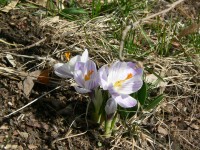
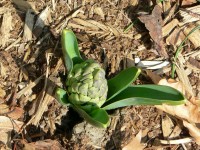
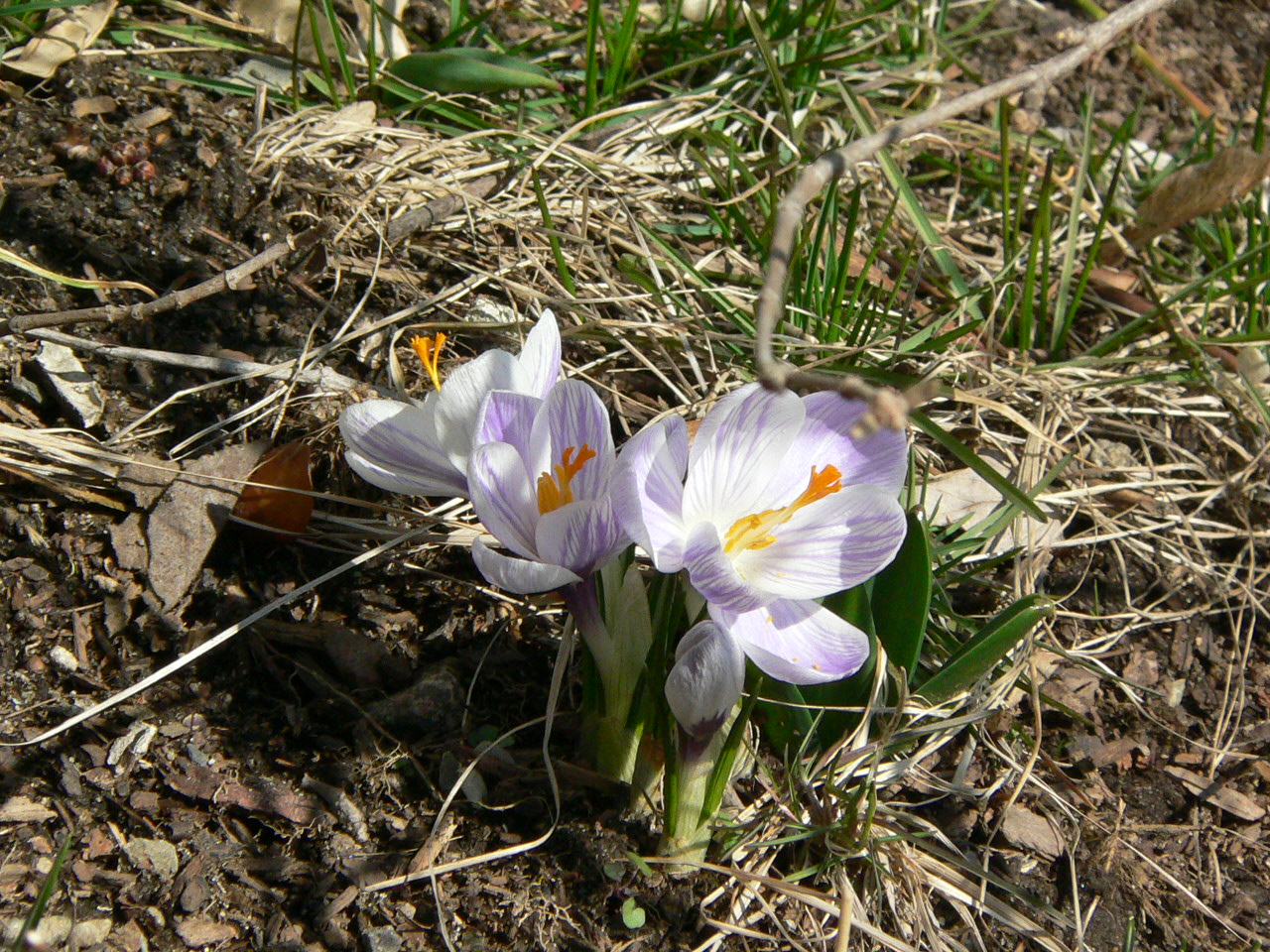
But in the meanwhile, here are some photos from around the yard, taken in the middle of March.
Some day, I should really read that book. It’s been sitting on my “things I ought to have read by now” queue for at least a decade.
But in the meanwhile, here are some photos from around the yard, taken in the middle of March.







The scene is a small cafe in a town that perfectly fits the stereotype of the empty, dusty, wild, old west. Dust blows by on a constant wind. It would not be surprising to see tumbleweeds and horsemen men wearing ten-gallon hats appear in the window at any moment.
There is not a cloud in the brilliant blue sky, where the twin suns shine with almost blinding brilliance. (Twin suns? Wait; that’s something a little different. And there are other things that see a little anachronistic. A little bit of technology here and there…)
A mother and her boy are eating lunch in the cafe. The boy is playing with a toy gun, and begging his mother for a real gun. The boy brandishes his toy gun at imaginary outlaws. At the next table, a young man is eating. He pays little obvious attention to the mother and boy. He is eating with gusto.
The young man is tall and thin, and his features are sharp and angular. His blond hair is spiky, pointing in every direction. He wears a long duster, but no hat. He is eating in large, eager bites. He looks awkward and goofy as he eats. He has the figure and movements of a adolescent who had just gone through a growth spurt.
From outside, we see a shadow fall on the door. Inside again, we see the door of the cafe burst inward off its hinges and five gunmen run in, guns drawn and shooting wildly at the young man as fast as they can pull their triggers. The mother pulls her boy aside to shield him with her body. The boy drops his toy gun. The young man is caught lifting his fork to his mouth. He dives to the floor, but there is nowhere to go. The gunmen keep firing. When we see the young man again, he is face down on the floor. A dark red pool surrounds his head and upper body. The pool gets larger as we watch.
The gunmen begin to celebrate; they are suddenly very wealthy men. The young man is an outlaw with an enormous bounty on his head. But they are not fools, and they are still on their guard.
The leader tells one of the others to go and pick up the body so they can take it to collect the reward. He approaches cautiously. He is afraid of the dead man. He tells himself that it is hard to believe that the young man could have been slain so easily. The young man has a fearsome reputation.
He turns over the body, and we see the face of the young man. His eyes are open, and he is smiling. He is covered with tomato juice, not blood. He reaches up and grabs the gun. The gunman gasps in surprise and dismay, but cannot shoot. The young man takes the gun out of the gunman’s hands.
The leader of the gunmen has not noticed He is telling the staff of the cafe, who are still huddled behind the counter, to cheer up. The danger is over, and once he gets the reward money, he will even reimburse them for the damage to the cafe.
“I’m so relieved! I was very worried about that,” announces the young man, in a sing-song voice. He is now on his feet, holding in a headlock the man whose gun he has taken.
The gunmen wheel to face the young man again. “Kill him!” shouts the leader, aiming his weapon.
There is an unexpected popping noise, and suddenly each of the gunmen has at least one toy suction-cup dart stuck to his face or forehead. The young man is holding the boy’s toy gun in his hand. None of the gunmen fire their weapons. Their weapons don’t seem to work.
“What’s the rush? Can’t we just talk this over?” asks the young man. He releases his hold on the gunman, pockets the gun, sits back down in his chair, and laces his hands behind his head. The gunmen are frozen in shock for a moment, but only for a moment.
“I’ll kill you!” threatens the leader.
“Are you insane?” screams one of his minions, restraining the leader. “Do you want to die? He just shot all of us. The next time, he might use real bullets!”
“It’s OK; shoot if you want. Go ahead, try your luck,” answers the young man cheerfully, with a smile on his face. He is not taunting them. He is inviting them.
The leader puts his gun in the young mans face and pulls the trigger. There is no gunshot. There is only the click of the hammer falling on an empty chamber.
“Give it up,” suggests the young man, consolingly. “Your guns are all empty, except for his,” continues the young man, gesturing at the man whose gun he has taken.
“How can you be sure?” asks the leader, trembling in rage.
“I counted,” replies the young man.
After leaving all their guns in a pile at his feet, the men–no longer gunmen–walk away, out the door, and down the road. The young man watches them until they are gone, and then he gives the toy gun back to the boy, and thanks him politely.
The young man sits back down and begins to eat again. He does not appear to notice the waitress who is now standing behind him. She is holding a snub-nosed pistol two inches from the base of his skull, and a look of disappointment crosses his face when he hears her cock the hammer.
Or something like that. I’m not great with details.
The young man is Vash the Stampede, protagonist of the serial “Trigun”, which has been rendered in both anime and manga (apparently with some differences, although I have only seen part of the anime, so I cannot say more).
Vash has a bounty of sixty billion (that’s right, billion with a B) “double dollars” on his head, dead or alive–and preferably dead.
Disaster follows wherever he goes, because everywhere he goes, a bounty of this magnitude ensures that there are always lots of people trying to kill or capture him–both bounty hunters, and ordinary citizens. This has earned him the nickname of “The Humanoid Typhoon” and his appearance in a town is rated as a potential “class G disaster” by the insurance adjusters. An ordinary typhoon rates a “class D” or so.
Vash earned a high price on his head some number of years before the narrative of the series begins (seventeen, if I have my history correct) when he was incorrectly credited with the destruction of the moderately-sized city of July with something a casual observer might mistake for a tactical nuclear weapon.
Dale Carnegie would cluck his tongue disapprovingly at the use of such a weapon as a way to make friends, although he would grudgingly admit that it certainly influences people.
After the incident in July, he vanished. But something has changed recently. He has resurfaced, and bounty hunters are converging on his reported location. Entire towns pursue him on a rumor, eager for the bounty. Other towns flee on rumor of his arrival, eager to not die.
Fortunately, Vash has a preternatural ability to avoid, or, if necessary, survive dangerous situations. He is a gunfighter of seemingly supernatural ability. He can dodge bullets, and his shooting accuracy and speed are phenomenal. He can hit separated targets so quickly that observers have a hard time telling how many shots were fired.
But he looks like a gawky teenager, and often acts like a bumbling fool. It’s usually hard for people to believe that Vash actually is Vash (which makes it possible for him to hide in plain sight). At one point, he is hired as a body guard to protect someone from Vash. At another point, he is hired to impersonate Vash (after all, he’s blond, tall, and thin, just like the real Vash). In at least two situations, he is threatened by another outlaw who is claiming to be Vash in order to bolster his reputation. Vash goes along with all of this. He rarely tells anyone that he’s Vash, and when he does, it’s even more rare that anyone believes him.
He is pursued by Meryl and Millie, two agents of a large insurance company, who are taking a terrible loss paying off the claims of everyone who gets caught in the crossfire. The agents are not trying to kill or capture Vash–they just want to keep him away from their policy-holders, insured property and any other potential sources of liability.
But nobody has been killed. After the massacre in July seventeen years ago, Vash has not killed anyone. He is avowed pacifist, and goes to great lengths (and endures terrible tortures and hardship) to avoid harming anyone–even people who are trying very hard to harm him. He even goes out of his way to help and protect other people, although this never seems to be in his best interest.
It’s fun to see how he escapes from each situation, and the first third of the story seems to largely be taken up by this.
But it’s even more fun to think about the deeper mystery. The pieces don’t quite seem to add up. Why does a pacifist have a $$60,000,000,000 bounty on his head? Was he bad before, and then turned over a new leaf?
No. That would be too simple.
Vash, it turns out, is is neither young (being well over 100 years old) nor human, although this apparently does not become clear until much later in the narrative, when the back-story is revealed through flash-backs.
Vash is a plant: a super-intelligent, super-being created via very advanced technology, the secret which has been lost in the meanwhile in a series of cataclysms. Plants are used for many things–they are at the heart of seedships that brought humans to this planet 146 years before the story begins, providing power and guidance. They are also, more mundanely, used to control the climate around the towns in the harsh, deadly planet on which this story unfolds. Most plants are housed–or perhaps imprisoned–in large, translucent shapes that look very much like enormous light bulbs. They cannot survive outside of this environment, but can somehow provide energy and information to their surroundings. Without plants, the humans would not be able to survive very long at all on this planet. Each town is protected from the surrounding desert by one or more plants, and when those plants become sick or their environment malfunctions, the town is usually doomed.
Vash is a different kind of plant. He is not like his predecessors; he appears human, is fully sentient (as well as being gifted in many ways), and can live in the world. It’s not clear what purpose his creators intended for him, but perhaps it was planetary defense. Vash carries a weapon capable of blasting a hole the size of Brazil in an object as far away as the moon. This weapon was a gift to Vash from his twin brother, Knives.
Now it should go without saying that if you ever have a hand in choosing the name of a super-intelligent super-being intended to help protect and shape the destiny of your civilization, you shouldn’t suggest the name “Knives”. It is the kind of suggestion that can really come back to bite you in the ass.
Knives is Vash’s equal or superior in every way, but not his equivalent. They have very different personalities. The primary example of this is that as children (several months old, but already resembling juvenile humans), Vash and Knives encounter a butterfly caught in a spider web. As the butterfly desperately tries to escape, and the spider closes in for the kill, Vash watches in horror, paralyzed, unable to decide what to do. Knives, in contrast, does not hesitate at all. Knives joyfully kills the spider and releases the butterfly.
Vash is furious. He wanted to save them both. He was trying to find a way that let the butterfly go without causing the spider to starve.
Vash considers all killing to be wrong. Knives considers killing to be an expedient solution to certain sorts of problems, and he is utterly certain that his decision was correct. And, more importantly, Knives considers all humans to be the moral equivalent of spiders, living off the lifeblood of the plants. Having ruined Earth, humankind is attempting to colonize planets throughout the galaxy. Knives does not think that this is a good idea, because he believes that humans will eventually destroy any worlds they settle. So he resolves to prevent this from happening, by attacking the problem at the root and exterminating all humans.
The only thing really standing in his way is Vash, but here Knives is given a difficult puzzle to solve. Vash is opposed to the murder of all humans, and will fight to protect them. But Knives, in his own way, loves his brother and doesn’t particularly want to be alone forever (except for a bunch of stupid plants) after he’s killed everyone. If only there was some way to convince Vash that killing humans wasn’t always wrong…
Their last conversation on this subject escalated into the destruction of the town of July. It took them both some time to recover after that, but now Vash is back.
So Knives sends a long string of assassins, many of whom he has given superhuman abilities, and who are cruel and cunning, to try to kill Vash. They take his friends hostage, and even torture or kill them to try to draw him into traps.
Knives doesn’t particularly want Vash to die (although that wouldn’t be worst possible outcome)–he wants Vash to be forced to kill the assassins.
Eventually, Knives is successful. Vash is forced to choose between killing Legato, Knive’s right-hand man, or watching his friends die a horrible death. Vash is devastated at having become a murderer, but he admits the logic of its necessity. Inaction can cause death as easily as action. Sometimes a choice needs to be made, and it can be made rationally.
Knives has achieved his goal, but does not see the gaping hole in his logic.
Vash sets out on foot, into the desert, to find his brother, and kill him.
Now, don’t you want to run out and read the book? Go ahead, it’s on Amazon, or you can watch the anime on youtube.
The other day, I wrote a blog entry that caused some degree of head scratching. Given my small readership, I won’t say it was a lot of head scratching, but percentage-wise, it was a pretty alarming amount.
It always bugs me when I’ve tried to explain something clearly and I’ve clearly failed. So, I tend to try, try again. Because, after all, after you’ve failed, the only thing possible is to improve, right? Well, that and fail to learn from your mistakes and repeat them. I guess there’s always that.
You can read the blog entry here. If it all makes sense to you, fine. If not, please continue.
Below is the conclusion to the ghost story, told a slightly different way, but the differences are completely meaningless. I’m just hoping that they make the point easier to grok.
***
The next morning, the man returned to the sage and, with some embarrassment, told him everything that the ghost had said.
“I do believe that the ghost follows you everywhere, even when you visit me,” said the sage, “and her attention to detail and her recall are extraordinary! But nevertheless, I do not think that I will have any trouble with her, and soon you will both have peace.”
The sage explained his plan. He would write a magic spell on the mans forehead that would drive away the ghost. If the ghost read it, she would be banished forever. The trick would be to make the ghost read it.
“But wait,” interjected the man. “She is undoubtedly here right now, watching us and listening to us. She will know about the spell, and she will know not to read it.”
The sage smiled and assured the man that the magic would work anyway, then, using a delicate brush, wrote the incantation on the mans forehead, and gave him a hat to wear.
“Don’t take off the hat until you see the ghost,” he warned the man. “We need to surprise her. If she tells you that the magic words are harmless to her, then she is probably only pretending to read them. Call her bluff and ask her to prove she knows what they say.”
That night, the ghost appeared again, and began her tirade. She told him that she had seen the incantation that the sage had written, and it had no power over her. His heart sank, but he resolved to try anyway.
“If the magic words have no effect on you, then please tell me what they are,” requested the man. “I cannot read them myself.”
But there was no answer. The room was empty and silent room. The ghost had vanished.
The man never saw the ghost again, although sometimes he thought he could still feel the spirit of his first wife, watching over him, at peace.
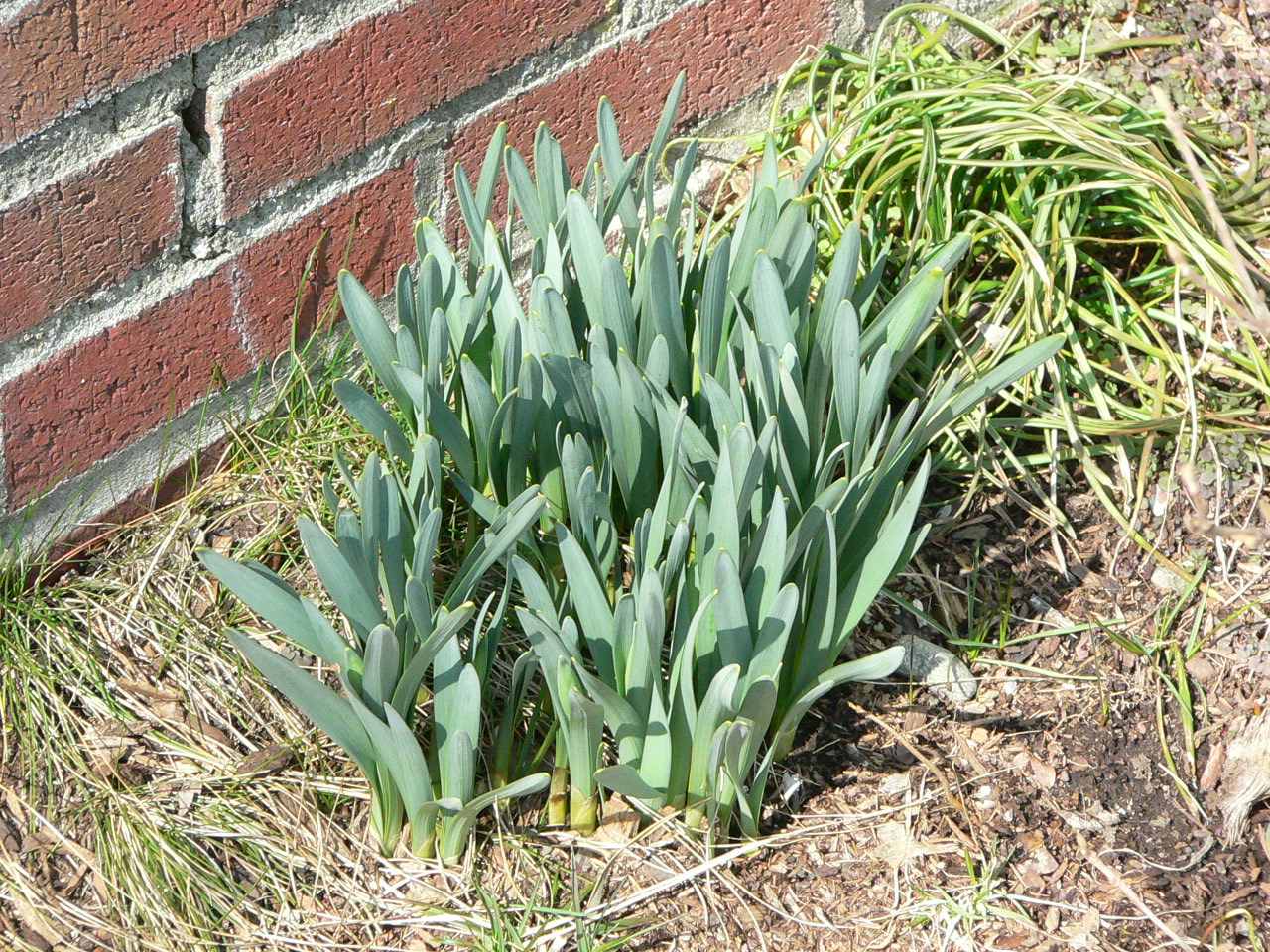
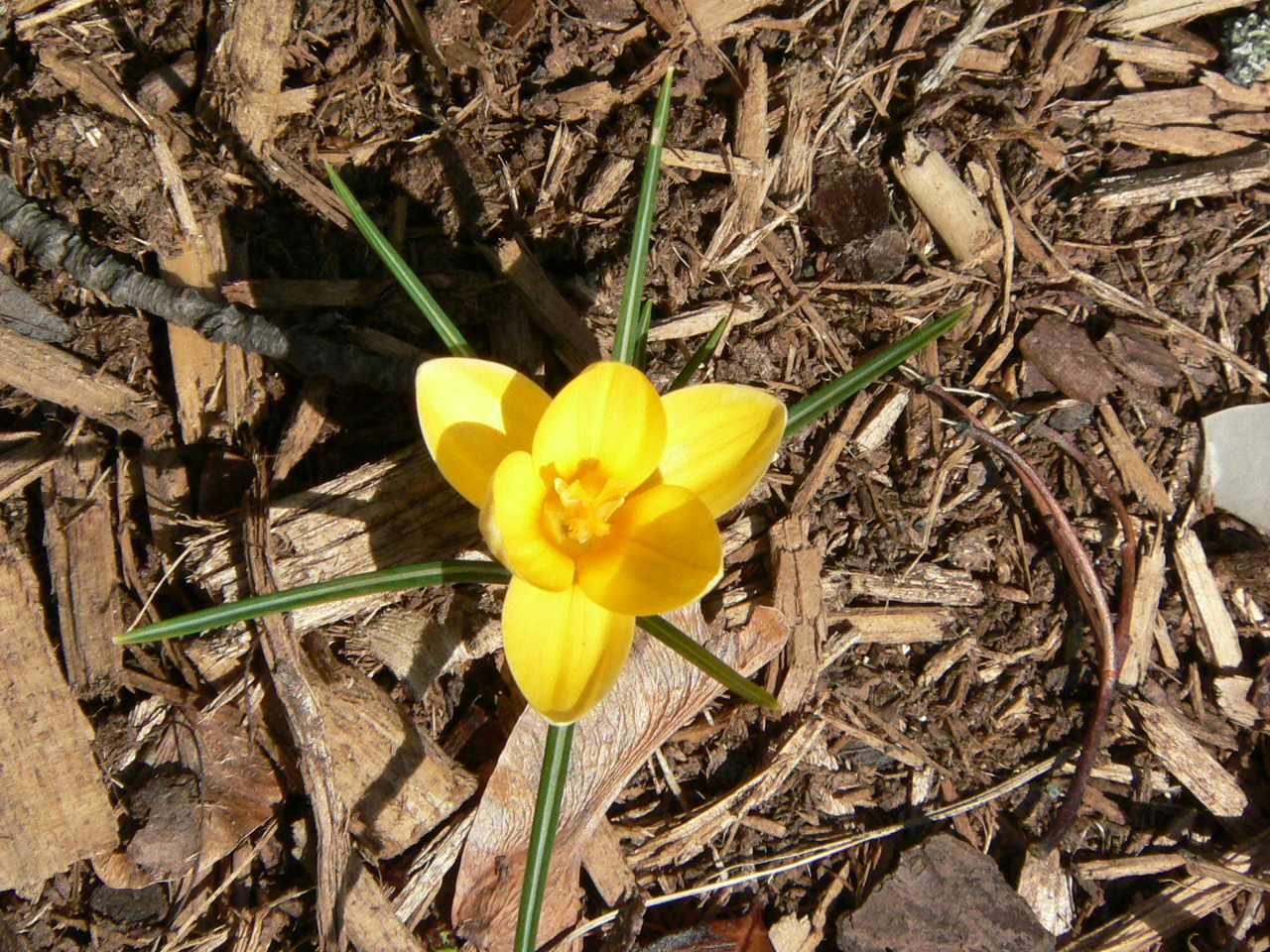
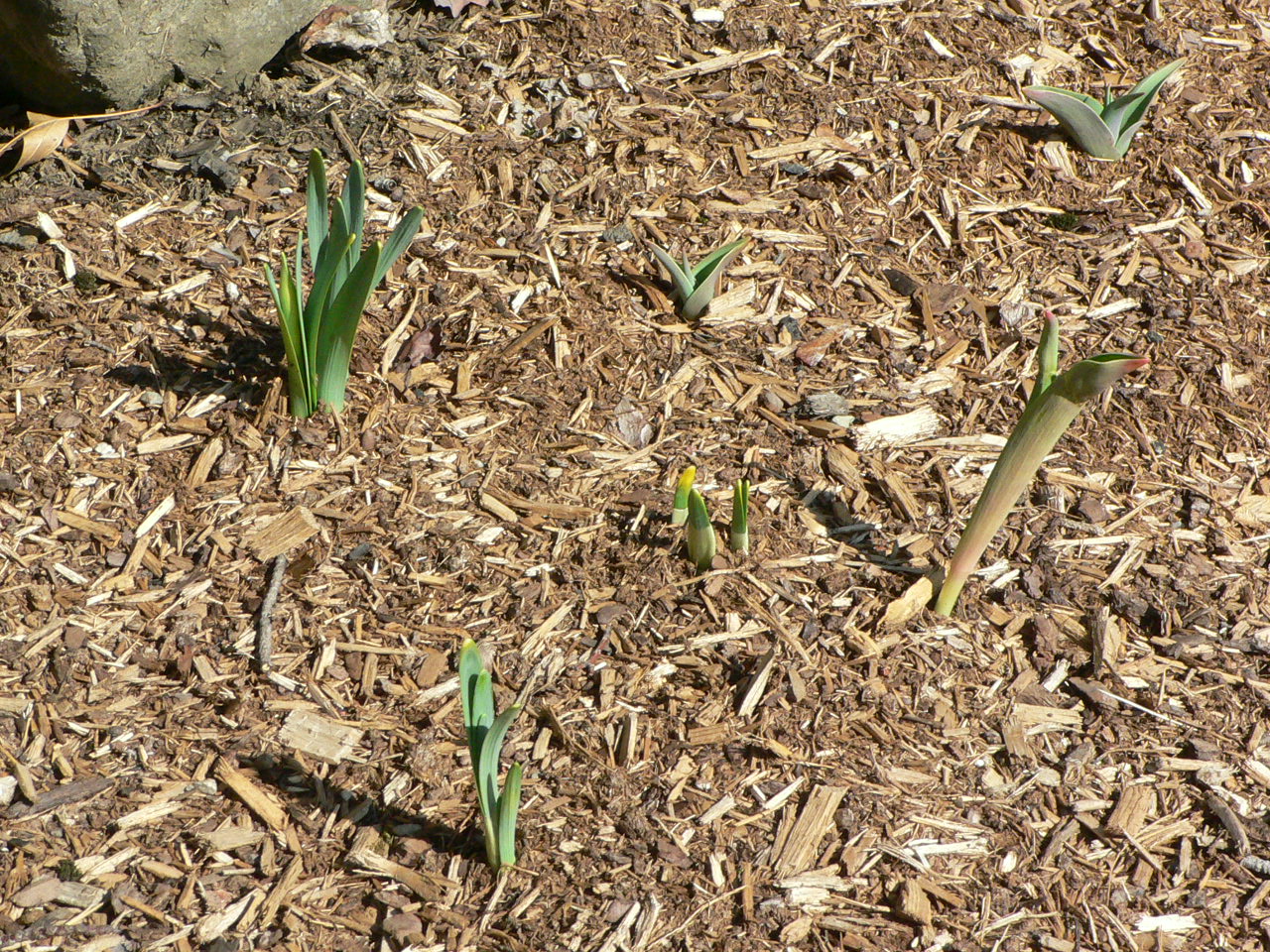
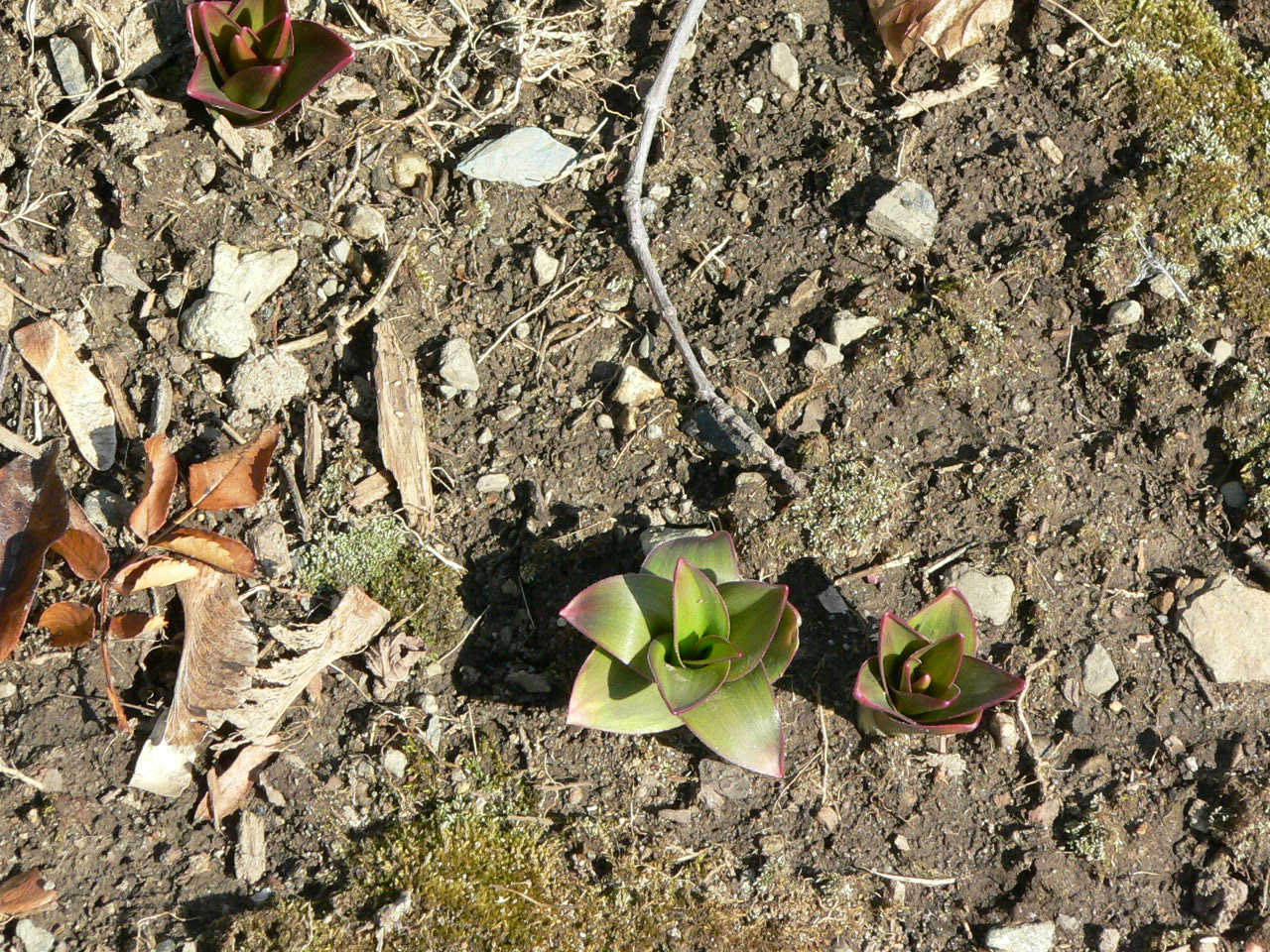
Things are starting to perk up.
I can’t figure out how to put captions on the photos, so I’ll just do this textually…
Reading row by row, top to bottom:
I planted a large number of mixed tulips from the same source, and so far none of them have sprouted to the surface at all. I hope they weren’t all bad bulbs… but then again, that will give me something to do this season, if I have to replant them all.
Note: I didn’t write this story. It’s very old. But I like it and I’ve decided to recite it, with a little editing, for your enjoyment.
As long ago and as far away as your great-grandmothers cradle, there lived a husband and wife who loved each other very much.
One day the woman fell mortally ill. She told her husband that she would forsake the afterlife to stay with him in this world, as a ghost. He urged her not to, but this made her believe that he had already begun to forget her. “I will remain as a ghost, and I will watch over you. But if you forget me, I will be angry and cause much mischief in your life,” she told him, with tears in her eyes.
The woman soon died. The man mourned deeply, but in the fullness of time his life returned to normal. Sometimes he indeed felt as if the spirit of his lost wife was watching over him, but these times grew less and less frequent.
Eventually the man met another woman. They became friends, then realized that they were in love, and became engaged.
The night after the engagement, the ghost of the dead wife appeared to the man and accused him of being unfaithful. She had been watching over him constantly, she said, and had become furious when he became engaged. She criticized every detail of his courtship with his new fiance. She knew everything; every little detail of every private moment and conversation they had shared. The man was devastated.
The ghost continued to reappear over the course of the next several nights, until finally the man was desperate. He had not been able to sleep for days, because it was when he was alone at night that the ghost would appear.
The man consulted with a local sage, and told him the entire story.
The sage was particularly impressed with the knowledge demonstrated by the ghost. It was clear that she followed the man everywhere and remembered even the slightest details that could be used in her nightly tirades.
“Come back tomorrow, and tell me how your evening goes tonight. I think I know how to make the ghost leave you in peace, but it will take some time to prepare,” the sage told the man.
That night, the ghost came to the man again. She told him that she had been watching when he visited the sage, had heard what the sage had told him, and was not worried. She told him that there was nothing the sage could do that would make her leave. She had no fear of the sage, and was amused by his strange mannerisms and affectations, which she recounted and mocked in detail.
The next morning, the man returned to the sage and, with some embarrassment, told him everything that the ghost had said.
“I do believe that the ghost follows you everywhere, even when you visit me,” said the sage, “and her attention to detail and her recall are extraordinary! But nevertheless, I do not think that I will have any trouble with her, and soon you will both have peace.”
The sage explained his plan. He would give the man a special box containing two compartments. In the inner compartment, he would place a small number of magic pebbles, and in the outer compartment, he would write out instructions for how to use the magic pebbles when the ghost appeared. Because the magic in the pebbles would only be potent for a very short time once the box was opened, it was crucial that the man not open the inner compartment of the box until the ghost appeared.
The sage showed him the empty box, and how to open it, and then asked the man to wait for a moment while he went to the storeroom where the magic pebbles were stored, and to write out the instructions.
“But wait,” interjected the man. “She is undoubtedly here right now, looking over our shoulders. She will know about the box, and she will know about the pebbles. She will have all day to prepare a counter for them. How do you know that they will still work?”
The sage smiled and assured the man that the magic would work anyway, and then he excused himself and went to the storeroom. In a few minutes, he returned with the box. The box now rattled.
That night, the ghost appeared again, and began her tirade. She told him that she had seen the magic pebbles, and they were nothing she need to fear. She had also seen the instructions that the sage had written, and they were useless. His heart sank, but he resolved to try anyway.
He opened the outer compartment, pulled out the instructions, and began to read.
“The ghost has probably told you that she has seen the pebbles and these instructions,” he read. “If not, please ask her about them. I am sure that she watched me put them in the box, and will say that their magic has no power over her.” The man already knew this to be true, so he continued reading.
“After she has told you that she watched me put the pebbles in the box, ask her how many pebbles I put in the box.”
“How many pebbles are in the box?” asked the man, to an empty, silent room. The ghost had vanished.
The man never saw the ghost again, although sometimes he thought he could still feel the spirit of his first wife, watching over him, at peace.

|
| A reasonable likeness |
Powered by WordPress