Words of Danny O'Bigbelly My idea of a good time

May 20, 2010

Facing the awful truth

Filed under: Nonsense I've spouted — DannyO @ 4:12 am

Facebook status messages are like haiku: limited in length, with a fixed format, and intended to capture the essence of the author’s feeling at a moment in time.

Remember, I wrote “like”. There’s a fleeting similarity.

Here are some of my favorites. I hope you’ll find them trite and annoying.

February 3, 2009: Friendship is a lot of work, can take a while to get started, can be sticky and slightly smelly in a yeasty way, and get cinnamon all over the place. Amish Friendship Bread, I mean. Ten days until the next batch rises enough, and we’ve eaten almost of half of this batch already…

February 6, 2009: Bigbelly Wife won the office superbowl raffle: the prize is a monster bag of chips, a big bag of doritos, a sack of pretzels and pile of pistachios, jars of salsa and queso dip, all of which we need like a hole in the head.

February 6, 2009: The saddest words of tongue or pen are simply this: how great would the Rolling Stones have been if they’d had the foresight to ditch Mick Jagger about thirty years ago?

February 9, 2009: My facebook home page has been involuntarily simplified. Am I supposed to be excited that I need to learn where everything is yet again? You know what would excite me more? If someone would simplify something about my life that IS ACTUALLY COMPLICATED AND IN NEED OF SIMPLIFICATION. I stand ready.

February 10, 2009: If I could play guitar, this is what it would look and hope to sound like: this guy sort of looks like me, he’s crackerjack on guitar, I love TMBG (esp this song), and I leave my clothes all over the floor too. http://www.youtube.com/watch?v=M4yRIHFibzY

February 12, 2009: 100 billion is approximately the number of galaxies in our light cone, the average number of stars in each galaxy, the number of people ever born, the number of neurons in each human brain, and the number of atoms in each neuron. And the number of times I’ve checked my email.

February 13, 2009: Every year around this time I am reminded of the joke about the man who checked out the book titled “How to Kiss” the day before Valentines Day, only to discover that it was a volume from an encyclopedia.

February 14, 2009: Happy Chinese New Year! OK, I’m going to get crap for calling it that, from my friends who are asian but not Chinese. But “Happy lunar new year for most people who celebrate the lunar new year, except the Jews, who do their own thing in the late summer for some reason” just doesn’t have the same ring to it.

February 15, 2009: Watching hockey on TV just doesn’t work. At least not on my TV. The damn puck is too small, camera angles keep changing, the crowd smells like my living room, and when I begin to assert that the goalie is actually a sieve, or that the ref has brought his lunch, my wife gives me the evil eye. What’s gotten into her?

February 17, 2009: Tuesday evening: snowplow stuck in front of the house; can’t get enough traction to make it up the hill. Assuming that I can chop a hole in the ice berm at the end of the driveway, I predict that the Wednesday morning commute will be a slice of the human experience.

February 17, 2009: Sometimes an angel whispers a secret in your ear and you suddenly recognize a deep truth that explains a mystery or a pattern in your life. I had a moment like that on Monday. Here’s the revelation: I’ll eat anything with crabmeat in it. (Yes, my angel has been phoning it in recently, but when she’s on her game she’s awesome.)

February 18, 2009: I think my iPod is bipolar. Listening to it in shuffle mode; it keeps going back and forth between Gloria Estefan and Nine Inch Nails.

February 18, 2009: That “Feed your senses” Friskies advertisement during the Olympics? Wow. I haven’t seen anything that psychedelic since college, if you know what I mean. http://www.youtube.com/watch?v=3Q4JLsNtDsM

March 5, 2009: Today is going to be one of those weeks.

March 5, 2009: Why couldn’t Levi have written a book and Sarah Palin posed nude? (yes, I stole this)

March 7, 2009: There is a large earthworm living in the flowerpot with the asiatic lilies. He popped up for a look when I moved the pot yesterday, and then disappeared back into the soil. He’s easily a foot long. This raises many questions, such as how he survived being frozen all winter, and how he got into a flower pot in the first place.

March 8, 2009: This movie will make you cry bittersweet tears of why can’t Hollywood do anything like this? Oh, and the regular kind of tears as well. It’s a three-hanky. http://www.youtube.com/watch?v=48ivIU6Szok

March 15, 2009: Money cannot buy a wet-vac, sump pump, drain pump, or hydraulic cement anywhere in Boston, as far as I can tell. The neighbors have loaned us their wet-vac, but if their basement starts to flood also, I’m sure they’ll want it back, and we’ll be hosed. I have some hydraulic cement. Anyone want to trade?

March 16, 2009: At breakfast this morning, my friend wore a green tie patterned with yellow octopi, tentacles flailing. Several people commented on his tie, thinking that it was a Saint Patrick’s Day thing, believing that each octopus was a shamrock. They felt that their trust had been betrayed when they saw the truth. But, then again, why would shamrocks be associated with the man who drove all the octopi out of Ireland?

March 16, 2009: Having my basement flooded and staying up through the night trying to bail, getting no sleep, and missing work, has given me a deeper appreciation for how safe and secure my life is compared to people in Haiti and Chile and elsewhere in the world where people put up with much worse things every day of their lives.

March 21, 2009: These “Tea Party” folks don’t know the first goddamn thing about parties. I’m certainly not inviting any of them to any of mine. They should just call themselves “Tea Hooligans” and be done with it. http://www.washingtonpost.com/wp-dyn/content/article/2010/03/20/AR2010032002556.html

March 22, 2009: So, the US will soon have universal health care… we must beware. Look at what happened to Austria, Belgium, Bulgaria, Croatia, the Czech Republic, Denmark, Estonia, Finland, France, Georgia, Germany, Greece, Hungary, Iceland, Ireland, Italy, Latvia, Lithuania, Luxembourg, Monaco, the Netherlands, Norway, Poland, Portugal, Romania, Slovakia, Slovenia, Spain, Sweden, Switzerland, Ukraine, the United Kingdom, Australia, New Zealand, Singapore, Taiwan, Thailand, Israel, India, Hong Kong, Japan, South Korea, Canada, and of course, the horror that is Costa Rica.

March 23, 2009: Quasi-paradise lost. http://www.youtube.com/watch?v=o_QePidL750

March 26, 2009: Goldfinch at the bird feeder shrugs the snow off its wings and thinks of August, golden fields of thistle, warm sun, and that bikini she used to wear before she had the kids, got cellulite, and started to feel self-conscious about her figure.

March 26, 2009: When I heard the news, for a moment I was as speechless as a deaf-mute holding a large load of freshly-folded laundry.

March 29, 2009: I guess I’m not too old for a sudden crush. Applegirl has it all: multiple iPhones, fingernails all the colors of my imagination, a gnarly ring, the coolest leggings and throw pillows, a great apartment, oodles of charm, good manners, and exquisite taste in music. Not to mention that she’s female and has hair and a smile like a Disney princess. http://www.youtube.com/watch?v=nzh2UygPwDU

March 30, 2009: There are birds on my birdfeeder right now. This is not an unusual event, in and of itself, but if you knew what the weather was here, you’d understand what I mean when I say that I am impressed with their tenacity.

March 30, 2009: I know that rain is believed to be the tears of god by some folk. If so, I’ll thank him for not getting all emo in my basement tonight.

March 31, 2009: 1981: I held the corsage in one hand and rang the doorbell with the other. Her older sister opened the door. “She’s not ready. There’s a problem with the dress,” she lilted. I heard the sounds of a sewing machine running and a woman fretting upstairs, where I had never been. “Would you like to play chess, or maybe cards?” she asked. “It wouldn’t be nice for me to leave you to wait alone, and we have plenty of time.”

April 2, 2009: It should go without saying that if you ever have a hand in choosing the name of a super-intelligent super-being intended to help protect and shape the destiny of your civilization, you shouldn’t suggest the name “Millions Knives”. It is the kind of mistake that can really come back to bite you in the ass. This is something every parent should know instinctively.

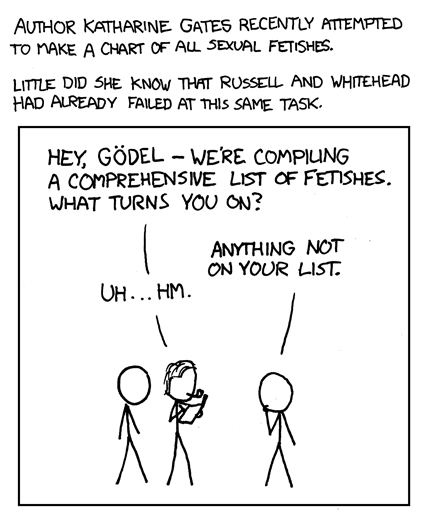
April 3, 2009: The axiom of choice is all you need to prove that I will never be a mathematician. http://imgs.xkcd.com/comics/fetishes.png

April 3, 2009: Woke up on the wrong side of the bed. Yikes! You see, my wife likes sleeping in a particular position, which in turn defines where I may sleep, how we snuggle, etc. But there are women, perhaps, who sleep facing in the opposite direction. So when she wakes up and finds that I’m sleeping on the wrong side of the bed, facing the wrong way, draping the wrong arm around her, she suspects I’m dreaming of Someone Else.

April 4, 2009: Do I want an iPad? Or a Nook? Or a Kindle? Or should I be content with just the free Kindle reader for the mac, which turns my laptop into a big Kindle, more or less? Or are they all wastes of want? I don’t even know what to covet any more. The advertisers are NOT doing their job. I have no lust for young tech any more.

April 15, 2009: The good news: my daughters trounced all comers in the form of teams of trivianauts gathered from every corner of the globe and took home the grand prize. The bad news: the topic of the questions was Disney Movie Characters. Oh, and maybe they weren’t really trivianauts–they might also be described as fellow travelers with nothing better to do. Have I succeeded or failed spectacularly as a parent?

April 15, 2009: I’ve been reading the Jefferson Bible–the new testament edited by Thomas Jefferson to remove the miracles and Jesus being the son of God. Jesus comes across as a smart guy with sensible and useful ideas. The miracles get in the way and provide a cop-out. We can’t be King James’s Christ–we can’t do miracles. But someone can be like Jefferson’s Christ, if he or she follows his teachings.

April 22, 2009: We have returned. The flight was mostly uneventful. I hope the mysterious concatenation of flights that our luggage is taking will prove to be as uneventful, and bring them around to Boston before too many more suns set. I suppose that the local customs regarding the appropriate amount to tip the skycap may be different in Boston and Orlando.

April 22, 2009: Goodbye, to some of you. My new rule: if you show up on my wall as joining some group that prays for someone to die, or wishes someone would die, or in any other way expresses the idea that you wish for or shall take joy from the death of another person simply because you disagree with him or her, that is the last time you will appear on my wall. I don’t care who that someone is; that’s not the point.

April 23, 2009: I’m watching a movie over the network from Netflix on my Wii. The future is here, and it looks sort of like VHS.

April 24, 2009: Poor Cinnamon… He keeps losing weight, except for the growth on his leg, which keeps getting larger. He can’t move around very well because his leg doesn’t work any more. And yet, he seems to be in fine spirits and makes no complaint. I think he’s just hanging on because he knows that when he dies, his elderly brother Pepper will die of loneliness within a matter of days. Rats are extremely social animals.

April 25, 2009: There’s nothing like the sound of your garage door spring exploding to let you know that there are many, many chores to do around the house.

April 25, 2009: I don’t get this. In college I wore Levis size 32/34. Now I wear size 40/34. Why did they change the sizes? Nobody is going to believe that I’m eight inches taller than I was in college.

April 27, 2009: The other day I got some email from my class committee, reminding me that our 25th college reunion is coming up. The implication of this milestone finally hit me this morning: this means that I’ve been sleeping with the same teddy bear for almost 25 years!

April 28, 2009: The lyrics of this song are one syllable shorter than a haiku. http://www.youtube.com/watch?v=wTrNQCYh70Y

April 29, 2009: ˙ʍou ʇɥƃıɹ llǝʍ ƃuılǝǝɟ ʇou ɯ,ı

April 30, 2009: This morning Cinnamon has only one working paw. He still shows no sign of pain or fear, just frustration that he can’t pick up his food. The end can’t be far away.

April 30, 2009: It’s nice to know that the local Indian bistro has a sense of humor. The mild korma was sweet, with a hint of raisins. The medium korma immediately ate through the plate, the table, the floor, the basement floor, the crust of the earth, and is now approaching the core of earth. Whatever part of the core is not already molten will be shortly. I’m glad I didn’t order the hot or very hot. I could only finish half.

May 1, 2009: I hadn’t watched ‘A Clockwork Orange’ for perhaps twenty years until I watched it again last night. Amazing. The film looks like it could have been made today–it’s still flawless, fresh, and terrifying. Are there any living directors with the combination of Kubrik’s genius of vision, mastery of the medium, and the colossal balls of granite required to make a film like this?

May 2, 2009: The selection of Netflix movies that are available to be downloaded and played immediately versus those that must be mailed versus those that are not available at all baffle and annoy me.

May 4, 2009: Last night I thought of a hilarious and incredibly insightful status update and I made a mental note to post it first thing in the morning. Unfortunately, that’s all I remember about it now.

May 5, 2009: When I was in school, I won a mexican hat-dancing contest. Word. I still have the award. I admit that I probably would have lost horribly if there had been any Mexicans enrolled, or if my teacher hadn’t taken such pity on me. I can imagine her thoughts: “Poor little Danny; this is probably the nearest he’ll ever be to winning anything in his life. I’ll let him have this moment.”

May 10, 2009: Every week, when we clean out Cinnamon and Pepper’s cage, I consider that it might be the penultimate time we do so. Maybe this will be the week. Maybe not. They continue to amaze me with their endurance, but everything has a limit.

May 10, 2009: Ironed the wrong bunch of shirts for this week. Gotta go back and do a few long-sleeved. Stupid weather.

May 11, 2009: I would like to know why there aren’t any songs like ‘The Waffle Stomp‘ on the radio any more.

May 12, 2009: Actual text of ad copy: “Since 1979, (company name omitted) has been producing quality (product name omitted) for over 21 years.” How should I read this? a) They’ve been producing it since 1958 and it’s a math puzzle. b) They haven’t updated their copy in ten years c) Previous, plus they never proofread it. d) Previous, plus viva la passive voice! e) Previous, plus people are going to buy it anyway.

May 13, 2009: Is Arizona doing this just to piss me off? It’s working. I mean, c’mon! They wouldn’t have permitted my high school English teacher–a man with literary awards stacked to the rafters–teach me poetry just because he’s from Vermont? http://www.huffingtonpost.com/2010/04/30/arizona-ethnic-studies-cl_n_558731.html

May 14, 2009: So… facebook thinks I’m gay, again. It’s showing me ads for things that don’t really match my interests. This is probably because some of y’all have such interests, and facebook doesn’t grok that it’s not a dating site, or that I really don’t care what or with whom you do with your privates in private. Facebook does.

May 19, 2009: Few songs capture my mood this morning. Here’s one that doesn’t: http://www.youtube.com/watch?v=gfLD-7bCtME

March 19, 2010

First impressions

Filed under: General,Nonsense I've spouted — DannyO @ 7:04 pm

The scene is a small cafe in a town that perfectly fits the stereotype of the empty, dusty, wild, old west. Dust blows by on a constant wind. It would not be surprising to see tumbleweeds and horsemen men wearing ten-gallon hats appear in the window at any moment.

There is not a cloud in the brilliant blue sky, where the twin suns shine with almost blinding brilliance. (Twin suns? Wait; that’s something a little different. And there are other things that see a little anachronistic. A little bit of technology here and there…)

A mother and her boy are eating lunch in the cafe. The boy is playing with a toy gun, and begging his mother for a real gun. The boy brandishes his toy gun at imaginary outlaws. At the next table, a young man is eating. He pays little obvious attention to the mother and boy. He is eating with gusto.

The young man is tall and thin, and his features are sharp and angular. His blond hair is spiky, pointing in every direction. He wears a long duster, but no hat. He is eating in large, eager bites. He looks awkward and goofy as he eats. He has the figure and movements of a adolescent who had just gone through a growth spurt.

From outside, we see a shadow fall on the door. Inside again, we see the door of the cafe burst inward off its hinges and five gunmen run in, guns drawn and shooting wildly at the young man as fast as they can pull their triggers. The mother pulls her boy aside to shield him with her body. The boy drops his toy gun. The young man is caught lifting his fork to his mouth. He dives to the floor, but there is nowhere to go. The gunmen keep firing. When we see the young man again, he is face down on the floor. A dark red pool surrounds his head and upper body. The pool gets larger as we watch.

The gunmen begin to celebrate; they are suddenly very wealthy men. The young man is an outlaw with an enormous bounty on his head. But they are not fools, and they are still on their guard.

The leader tells one of the others to go and pick up the body so they can take it to collect the reward. He approaches cautiously. He is afraid of the dead man. He tells himself that it is hard to believe that the young man could have been slain so easily. The young man has a fearsome reputation.

He turns over the body, and we see the face of the young man. His eyes are open, and he is smiling. He is covered with tomato juice, not blood. He reaches up and grabs the gun. The gunman gasps in surprise and dismay, but cannot shoot. The young man takes the gun out of the gunman’s hands.

The leader of the gunmen has not noticed He is telling the staff of the cafe, who are still huddled behind the counter, to cheer up. The danger is over, and once he gets the reward money, he will even reimburse them for the damage to the cafe.

“I’m so relieved! I was very worried about that,” announces the young man, in a sing-song voice. He is now on his feet, holding in a headlock the man whose gun he has taken.

The gunmen wheel to face the young man again. “Kill him!” shouts the leader, aiming his weapon.

There is an unexpected popping noise, and suddenly each of the gunmen has at least one toy suction-cup dart stuck to his face or forehead. The young man is holding the boy’s toy gun in his hand. None of the gunmen fire their weapons. Their weapons don’t seem to work.

“What’s the rush? Can’t we just talk this over?” asks the young man. He releases his hold on the gunman, pockets the gun, sits back down in his chair, and laces his hands behind his head. The gunmen are frozen in shock for a moment, but only for a moment.

“I’ll kill you!” threatens the leader.

“Are you insane?” screams one of his minions, restraining the leader. “Do you want to die? He just shot all of us. The next time, he might use real bullets!”

“It’s OK; shoot if you want. Go ahead, try your luck,” answers the young man cheerfully, with a smile on his face. He is not taunting them. He is inviting them.

The leader puts his gun in the young mans face and pulls the trigger. There is no gunshot. There is only the click of the hammer falling on an empty chamber.

“Give it up,” suggests the young man, consolingly. “Your guns are all empty, except for his,” continues the young man, gesturing at the man whose gun he has taken.

“How can you be sure?” asks the leader, trembling in rage.

“I counted,” replies the young man.

After leaving all their guns in a pile at his feet, the men–no longer gunmen–walk away, out the door, and down the road. The young man watches them until they are gone, and then he gives the toy gun back to the boy, and thanks him politely.

The young man sits back down and begins to eat again. He does not appear to notice the waitress who is now standing behind him. She is holding a snub-nosed pistol two inches from the base of his skull, and a look of disappointment crosses his face when he hears her cock the hammer.

Or something like that. I’m not great with details.

The young man is Vash the Stampede, protagonist of the serial “Trigun”, which has been rendered in both anime and manga (apparently with some differences, although I have only seen part of the anime, so I cannot say more).

Vash has a bounty of sixty billion (that’s right, billion with a B) “double dollars” on his head, dead or alive–and preferably dead.

Disaster follows wherever he goes, because everywhere he goes, a bounty of this magnitude ensures that there are always lots of people trying to kill or capture him–both bounty hunters, and ordinary citizens. This has earned him the nickname of “The Humanoid Typhoon” and his appearance in a town is rated as a potential “class G disaster” by the insurance adjusters. An ordinary typhoon rates a “class D” or so.

Vash earned a high price on his head some number of years before the narrative of the series begins (seventeen, if I have my history correct) when he was incorrectly credited with the destruction of the moderately-sized city of July with something a casual observer might mistake for a tactical nuclear weapon.

Dale Carnegie would cluck his tongue disapprovingly at the use of such a weapon as a way to make friends, although he would grudgingly admit that it certainly influences people.

After the incident in July, he vanished. But something has changed recently. He has resurfaced, and bounty hunters are converging on his reported location. Entire towns pursue him on a rumor, eager for the bounty. Other towns flee on rumor of his arrival, eager to not die.

Fortunately, Vash has a preternatural ability to avoid, or, if necessary, survive dangerous situations. He is a gunfighter of seemingly supernatural ability. He can dodge bullets, and his shooting accuracy and speed are phenomenal. He can hit separated targets so quickly that observers have a hard time telling how many shots were fired.

But he looks like a gawky teenager, and often acts like a bumbling fool. It’s usually hard for people to believe that Vash actually is Vash (which makes it possible for him to hide in plain sight). At one point, he is hired as a body guard to protect someone from Vash. At another point, he is hired to impersonate Vash (after all, he’s blond, tall, and thin, just like the real Vash). In at least two situations, he is threatened by another outlaw who is claiming to be Vash in order to bolster his reputation. Vash goes along with all of this. He rarely tells anyone that he’s Vash, and when he does, it’s even more rare that anyone believes him.

He is pursued by Meryl and Millie, two agents of a large insurance company, who are taking a terrible loss paying off the claims of everyone who gets caught in the crossfire. The agents are not trying to kill or capture Vash–they just want to keep him away from their policy-holders, insured property and any other potential sources of liability.

But nobody has been killed. After the massacre in July seventeen years ago, Vash has not killed anyone. He is avowed pacifist, and goes to great lengths (and endures terrible tortures and hardship) to avoid harming anyone–even people who are trying very hard to harm him. He even goes out of his way to help and protect other people, although this never seems to be in his best interest.

It’s fun to see how he escapes from each situation, and the first third of the story seems to largely be taken up by this.

But it’s even more fun to think about the deeper mystery. The pieces don’t quite seem to add up. Why does a pacifist have a $$60,000,000,000 bounty on his head? Was he bad before, and then turned over a new leaf?

No. That would be too simple.

Vash, it turns out, is is neither young (being well over 100 years old) nor human, although this apparently does not become clear until much later in the narrative, when the back-story is revealed through flash-backs.

Vash is a plant: a super-intelligent, super-being created via very advanced technology, the secret which has been lost in the meanwhile in a series of cataclysms. Plants are used for many things–they are at the heart of seedships that brought humans to this planet 146 years before the story begins, providing power and guidance. They are also, more mundanely, used to control the climate around the towns in the harsh, deadly planet on which this story unfolds. Most plants are housed–or perhaps imprisoned–in large, translucent shapes that look very much like enormous light bulbs. They cannot survive outside of this environment, but can somehow provide energy and information to their surroundings. Without plants, the humans would not be able to survive very long at all on this planet. Each town is protected from the surrounding desert by one or more plants, and when those plants become sick or their environment malfunctions, the town is usually doomed.

Vash is a different kind of plant. He is not like his predecessors; he appears human, is fully sentient (as well as being gifted in many ways), and can live in the world. It’s not clear what purpose his creators intended for him, but perhaps it was planetary defense. Vash carries a weapon capable of blasting a hole the size of Brazil in an object as far away as the moon. This weapon was a gift to Vash from his twin brother, Knives.

Now it should go without saying that if you ever have a hand in choosing the name of a super-intelligent super-being intended to help protect and shape the destiny of your civilization, you shouldn’t suggest the name “Knives”. It is the kind of suggestion that can really come back to bite you in the ass.

Knives is Vash’s equal or superior in every way, but not his equivalent. They have very different personalities. The primary example of this is that as children (several months old, but already resembling juvenile humans), Vash and Knives encounter a butterfly caught in a spider web. As the butterfly desperately tries to escape, and the spider closes in for the kill, Vash watches in horror, paralyzed, unable to decide what to do. Knives, in contrast, does not hesitate at all. Knives joyfully kills the spider and releases the butterfly.

Vash is furious. He wanted to save them both. He was trying to find a way that let the butterfly go without causing the spider to starve.

Vash considers all killing to be wrong. Knives considers killing to be an expedient solution to certain sorts of problems, and he is utterly certain that his decision was correct. And, more importantly, Knives considers all humans to be the moral equivalent of spiders, living off the lifeblood of the plants. Having ruined Earth, humankind is attempting to colonize planets throughout the galaxy. Knives does not think that this is a good idea, because he believes that humans will eventually destroy any worlds they settle. So he resolves to prevent this from happening, by attacking the problem at the root and exterminating all humans.

The only thing really standing in his way is Vash, but here Knives is given a difficult puzzle to solve. Vash is opposed to the murder of all humans, and will fight to protect them. But Knives, in his own way, loves his brother and doesn’t particularly want to be alone forever (except for a bunch of stupid plants) after he’s killed everyone. If only there was some way to convince Vash that killing humans wasn’t always wrong…

Their last conversation on this subject escalated into the destruction of the town of July. It took them both some time to recover after that, but now Vash is back.

So Knives sends a long string of assassins, many of whom he has given superhuman abilities, and who are cruel and cunning, to try to kill Vash. They take his friends hostage, and even torture or kill them to try to draw him into traps.

Knives doesn’t particularly want Vash to die (although that wouldn’t be worst possible outcome)–he wants Vash to be forced to kill the assassins.

Eventually, Knives is successful. Vash is forced to choose between killing Legato, Knive’s right-hand man, or watching his friends die a horrible death. Vash is devastated at having become a murderer, but he admits the logic of its necessity. Inaction can cause death as easily as action. Sometimes a choice needs to be made, and it can be made rationally.

Knives has achieved his goal, but does not see the gaping hole in his logic.

Vash sets out on foot, into the desert, to find his brother, and kill him.

Now, don’t you want to run out and read the book? Go ahead, it’s on Amazon, or you can watch the anime on youtube.

March 8, 2010

Ghost story redux

Filed under: General,Nonsense I've spouted — DannyO @ 5:59 pm

The other day, I wrote a blog entry that caused some degree of head scratching. Given my small readership, I won’t say it was a lot of head scratching, but percentage-wise, it was a pretty alarming amount.

It always bugs me when I’ve tried to explain something clearly and I’ve clearly failed. So, I tend to try, try again. Because, after all, after you’ve failed, the only thing possible is to improve, right? Well, that and fail to learn from your mistakes and repeat them. I guess there’s always that.

You can read the blog entry here. If it all makes sense to you, fine. If not, please continue.

Below is the conclusion to the ghost story, told a slightly different way, but the differences are completely meaningless. I’m just hoping that they make the point easier to grok.

***

The next morning, the man returned to the sage and, with some embarrassment, told him everything that the ghost had said.

“I do believe that the ghost follows you everywhere, even when you visit me,” said the sage, “and her attention to detail and her recall are extraordinary! But nevertheless, I do not think that I will have any trouble with her, and soon you will both have peace.”

The sage explained his plan. He would write a magic spell on the mans forehead that would drive away the ghost. If the ghost read it, she would be banished forever. The trick would be to make the ghost read it.

“But wait,” interjected the man. “She is undoubtedly here right now, watching us and listening to us. She will know about the spell, and she will know not to read it.”

The sage smiled and assured the man that the magic would work anyway, then, using a delicate brush, wrote the incantation on the mans forehead, and gave him a hat to wear.

“Don’t take off the hat until you see the ghost,” he warned the man. “We need to surprise her. If she tells you that the magic words are harmless to her, then she is probably only pretending to read them. Call her bluff and ask her to prove she knows what they say.”

That night, the ghost appeared again, and began her tirade. She told him that she had seen the incantation that the sage had written, and it had no power over her. His heart sank, but he resolved to try anyway.

“If the magic words have no effect on you, then please tell me what they are,” requested the man. “I cannot read them myself.”

But there was no answer. The room was empty and silent room. The ghost had vanished.

The man never saw the ghost again, although sometimes he thought he could still feel the spirit of his first wife, watching over him, at peace.

March 6, 2010

Ghost story

Filed under: Nonsense I've spouted — DannyO @ 5:37 pm

Note: I didn’t write this story. It’s very old. But I like it and I’ve decided to recite it, with a little editing, for your enjoyment.

As long ago and as far away as your great-grandmothers cradle, there lived a husband and wife who loved each other very much.

One day the woman fell mortally ill. She told her husband that she would forsake the afterlife to stay with him in this world, as a ghost. He urged her not to, but this made her believe that he had already begun to forget her. “I will remain as a ghost, and I will watch over you. But if you forget me, I will be angry and cause much mischief in your life,” she told him, with tears in her eyes.

The woman soon died. The man mourned deeply, but in the fullness of time his life returned to normal. Sometimes he indeed felt as if the spirit of his lost wife was watching over him, but these times grew less and less frequent.

Eventually the man met another woman. They became friends, then realized that they were in love, and became engaged.

The night after the engagement, the ghost of the dead wife appeared to the man and accused him of being unfaithful. She had been watching over him constantly, she said, and had become furious when he became engaged. She criticized every detail of his courtship with his new fiance. She knew everything; every little detail of every private moment and conversation they had shared. The man was devastated.

The ghost continued to reappear over the course of the next several nights, until finally the man was desperate. He had not been able to sleep for days, because it was when he was alone at night that the ghost would appear.

The man consulted with a local sage, and told him the entire story.

The sage was particularly impressed with the knowledge demonstrated by the ghost. It was clear that she followed the man everywhere and remembered even the slightest details that could be used in her nightly tirades.

“Come back tomorrow, and tell me how your evening goes tonight. I think I know how to make the ghost leave you in peace, but it will take some time to prepare,” the sage told the man.

That night, the ghost came to the man again. She told him that she had been watching when he visited the sage, had heard what the sage had told him, and was not worried. She told him that there was nothing the sage could do that would make her leave. She had no fear of the sage, and was amused by his strange mannerisms and affectations, which she recounted and mocked in detail.

The next morning, the man returned to the sage and, with some embarrassment, told him everything that the ghost had said.

“I do believe that the ghost follows you everywhere, even when you visit me,” said the sage, “and her attention to detail and her recall are extraordinary! But nevertheless, I do not think that I will have any trouble with her, and soon you will both have peace.”

The sage explained his plan. He would give the man a special box containing two compartments. In the inner compartment, he would place a small number of magic pebbles, and in the outer compartment, he would write out instructions for how to use the magic pebbles when the ghost appeared. Because the magic in the pebbles would only be potent for a very short time once the box was opened, it was crucial that the man not open the inner compartment of the box until the ghost appeared.

The sage showed him the empty box, and how to open it, and then asked the man to wait for a moment while he went to the storeroom where the magic pebbles were stored, and to write out the instructions.

“But wait,” interjected the man. “She is undoubtedly here right now, looking over our shoulders. She will know about the box, and she will know about the pebbles. She will have all day to prepare a counter for them. How do you know that they will still work?”

The sage smiled and assured the man that the magic would work anyway, and then he excused himself and went to the storeroom. In a few minutes, he returned with the box. The box now rattled.

That night, the ghost appeared again, and began her tirade. She told him that she had seen the magic pebbles, and they were nothing she need to fear. She had also seen the instructions that the sage had written, and they were useless. His heart sank, but he resolved to try anyway.

He opened the outer compartment, pulled out the instructions, and began to read.

“The ghost has probably told you that she has seen the pebbles and these instructions,” he read. “If not, please ask her about them. I am sure that she watched me put them in the box, and will say that their magic has no power over her.” The man already knew this to be true, so he continued reading.

“After she has told you that she watched me put the pebbles in the box, ask her how many pebbles I put in the box.”

“How many pebbles are in the box?” asked the man, to an empty, silent room. The ghost had vanished.

The man never saw the ghost again, although sometimes he thought he could still feel the spirit of his first wife, watching over him, at peace.

February 6, 2010

It’s been a while

Filed under: General,Nonsense I've spouted — DannyO @ 7:36 pm

As some of you know, I conceived of the idea of writing something resembling a full-length novel last summer, and have been toying with it ever since.

My first ideas were based on the story of Princess Lu, as outlined elsewhere in this blog. There’s a tremendous amount of backstory to the few things I’ve actually taken trouble to write down, and I personally think that it’s all very interesting, but it exists almost entirely in my imagination. Unfortunately, the stories and bits of dialog that I have in my head often turn out to be like those wonderful pebbles that you find at the beach: they don’t look so wonderful after they’re taken out of their environment, dried out, and set out for display.

The parts that I wrote down were not very well “reviewed”, if I may use that term loosely, because they failed to hold anyone’s interest long enough to make it through the first ten pages, as far as I can tell. I ended the last installment on a cliff-hanger, and expected to hear from people eager to find out what happened next–how will Princess Lu escape from the perils she faces; alone, dismounted, most of her kit destroyed, nearly unarmed, hundreds of miles from the nearest settlement, with some large creature racing at her? Well, she’s apparently on her own, because nobody seems all that interested.

There’s also the story about Joe-who-doesn’t-get-tenure, but I decided that was too interesting and complicated to be done piecemeal.

There’s also the story about a large, built-in-desperation spacecraft sent on a mission to meet some aliens at a nearby star system. The interesting (if I may be so bold as to use that word) aspect of this story is that it takes place in the very near future, and therefore uses technology that we would, for the most part, be able to find down at CostCo and/or Electric Boat today. It takes years to get there, and stuff like that. No faster-than-light travel, no magical technology, or anything unreasonable. The problem with that story is that although I have a great middle and dynamite end, the beginning is missing. I don’t know how to get the story started.

Around Christmas I thought about writing about driving across the country (without actually making the trip, unfortunately). I settled on this idea and worked on it for a while. I was getting into some deep insights about what it means to be a person like me, living in a time like this. You know, the usual mid-life crisis sort of thing. I thought I was making progress, but two events derailed the entire process.

The first was that one of my friends is going through the process of trying to get his own novel published. He has a lot of experience with writing, and writes much better than I do. He has fans and followers. His blog has more readers in a day than mine has had since it started. (My only regular readers are Google and Bing, and a few other search engines I’ve never heard much about, as far as I can gather.) And yet, despite his experience with writing, his popularity, and his impressive determination and amount of energy he’s putting into getting published, he’s having a difficult time. He’s making progress, but it’s taken a long time already, and there’s no telling how long the rest of the process might take. It’s pretty clear that you can be a good, ambitious, and hard-working writer and still have a hell of a time getting a book published. That makes my prospects look pretty thin, because I trail far behind on each of these qualities. Therefore, I concluded, if I’m going to write a book, it better be because I think the process is fun and enjoyable. I should write for myself, not for a publisher who will never exist or an audience I’ll never reach.

The second event was that I got a copy of “Inherent Vice”, Pynchon’s latest, for Christmas.

Pynchon is an acquired taste, or perhaps a communicable disease. Many people find him too difficult to read, or his sense of humor too odd or offensive. I also find him difficult to read (I can’t get very far into “Mason & Dixon” and keep stalling out after the first book, or chapter, or section, or whatever the hell it is, of “Against the Day”) and it’s certainly a fact that there are no good people in Pynchon’s world. Everyone has a flaw, or two, or a dozen, and Pynchon pulls no punches. The cops are bad, the villains are prosperous, the heroes do a lot of drugs, engage in casual sex, drive under the influence, order disgusting things on their pizza, don’t exercise regularly, and never floss. I love it. It’s what Wodehouse might have written, if Wodehouse had grown up in post-war California and done a bunch of acid during the 60’s.

The reviews for “Inherent Vice” are a mixed bag. The most positive ones say something along the lines of “It’s not Pynchon at his best, but even so he’s a better ride than pretty much anyone else” and the negative ones say things like “another incomprehensible mish-mash from Pynchon.” Sam Anderson of the New York Times Review of Books, didn’t even bother to write a review of the book, but instead wrote a two-page essay outing himself as someone who never liked Pynchon and can’t understand why anyone else possibly could, half implying that Pynchon’s popularity is probably due to some sort of self-perpetuating academic hazing ritual that forces everyone serious about literature to endure the ordeal of reading Gravity’s Rainbow. (I kept waiting for the punch-line because the structure and rhythm of Anderson’s essay is almost a perfect, although perhaps unwitting, parody of the story of Pointsman and Mexico from Gravity’s Rainbow, but it never came.)

Personally, I don’t care whether any particular person likes Pynchon, and am not going to try to convince anyone to read his books. My only desire is that enough people continue to buy his books so that his publishers will continue to offer them to me. I enjoy Pynchon. He makes me laugh. That’s really all I want from a novel. I’m sure Anderson wouldn’t like Wodehouse either (he doesn’t like things that are overly lyrical, or when the characters have silly, made-up names, or when the plots rely too much on serendipity), but I will make careful note of his reviews in the future. If it turns out that he doesn’t hate every book written by a living author, then I’ll just buy the books he hates, and I will thank him for his guidance.

So reading “Inherent Vice” made me rethink my plans. If I’m going to write a novel, it’s not going to be serious. It’s not going to be dramatic. It’s going to be funny, the characters are going to have silly names, there will be more serendipity than average, and nothing will be resolved. It’ll be fun to read. Otherwise, it won’t be fun to write.

So, where to begin? I watched from a safe distance as my friend upload his novel onto authonomy.com, and decided that might be a good place to get my novel in front of new eyeballs, assuming I ever write anything. There are hundreds or perhaps thousands of novels there, with an active community of readers, and perhaps if I upload my work there someone will stumble across it. It’s as good a plan as any.

One restriction of authonomy.com is that work must be uploaded as a .doc file, or .rtf. Neither is a particularly attractive choice. My learned opinion of .doc is that life is far too short to ever use any editor that produces it, especially Word. My opinion of RTF is not much higher–even the people who wrote RTF in the first place consider it an abomination and a sin against formatting–but at least it is a documented and markup-based standard, sort of. What this means is that it’s conceivable for people to write translators from real markup languages (the sort of things that people actually use for typesetting and writing and things of that ilk) to RTF without losing all of the goodness. Some of the goodness must be sacrificed because RTF is not as rich and expressive as real editing software–the sort of thing people use to write books, not church newsletters and memos that go straight into the recycling bin–but some remains.

I found a translator that turns a format I like into RTF. It works sufficiently well to produce output compatible with authonomy, but it has one large flaw. It ignores my selection of fonts, and always uses Times Roman. Now, there are worse fonts than Times Roman, but those seriphs don’t look good on the screen, and the kerning is awkward. I want a font that is easy on the eyes.

So I wrote a program that changes the fonts in an RTF file to be what I want them to be. That’s the sort of thing I do. It’s no big deal. Sure, I could do it by opening the RTF file in some RTF editor, select all, select a new font, and then save, but that would be work. Too many steps. I’d get it wrong every once in a while; better to let the computer do the repetitive stuff.

The only question is what font to use? There are so many, and so many opinions. But in the end, one font stood out from all of the others.

My book will be in Palatino.

That’s right. My book will be in Palatino.

That’s as far as I’ve gotten.

The software is ready and the font face has been chosen. Now for the hard part.

January 31, 2010

The story of Q

Filed under: General,Nonsense I've spouted — DannyO @ 8:43 am

Far away, and yet nearby, in the peaceful burg of Heisen, there live a king and a queen. They have always lived there, and always shall.

As is the custom of the land, the queen wears a new dress to dinner every night, and that dress is never worn again. At the time that our story begins, it had become a ritual for the queen to walk to the lower town every morning, and buy a new dress at the one (and only) dress store in Heisen. The store sold many different styles of dresses, but they were always made from the same fabric, and were always the same color–a perfect grey, midway between white and black.

One day the owner and tailor of the dress shop decided to retire and leave his business to his identical twin sons. Although the brothers were the best of friends, and had no animosity toward each other, each desired to run his own shop, and so they agreed to split the dress shop in half to form two smaller dress shops. Out of respect to their father, or perhaps because of their long apprenticeship under his tutelage, they continued to sew and sell the same fashions as he had, and their work was as difficult to tell apart as they were. They therefore made one large change, to distinguish themselves: one son would make only black dresses, and the other would make only white.

The queen, not wanting to show favor unequally, announced that she would decide which shop she would patronize each day in a secret but completely fair manner. Neither son would know ahead of time which shop she would visit each day.

When the king learned of this, he was both gladdened and dismayed. He was happy because the queen would have more variety in her wardrobe, but he was slightly dismayed because he thought it fitting that his outfit should match that of the queen, and, because in contrast to the queen, it is customary for the king to wear the same outfit to dinner every evening. The king was not sure what to wear that would match both black and white, but after consultation with his ministers, he selected an outfit that he thought would look equally good with both pure white or pitch black, and issued an edict to announce his change in dinner-wear.

The next evening, the king was mildly surprised when the queen entered the dining room wearing a beautiful dress of grey, just as she had before the elder tailor had retired. He assumed that perhaps the queen had a backlog of several grey dresses that she had purchased but not yet worn, and gave it no more thought.

But the next day, the queen wore another grey dress, and then the next day yet another. And then things became even stranger: it appeared as though the grey dresses were changing in brightness. Some days they would be lighter than others, and other days darker. They seemed to be perfectly white or perfectly black (although on some days, her dress did seem to be close to one extreme or the other).

At first, the king thought that perhaps his eyes were playing tricks on him. His new outfits, which contained many colors and hues, did not contain any shades of grey, and therefore he could not simply compare the color of his own outfit to the color of the outfit worn by the queen, as he had been able to do in the past. But as time went on, the king became more and more convinced that the queen was wearing different shades of grey on different nights, and as he became more convinced, he became more and more curious about how this could happen.

The king wondered whether perhaps his perception of grey had changed. He had the royal portrait painter create a portrait of the queen every night at dinner for a week, and every night he compared the portrait to the queen sitting across from him and saw that they were identical, but when he compared the portraits from different nights, he saw that they were different. And thus he proved to himself that the queen was wearing different shades on different nights, and it wasn’t simply his imagination.

The king considered the possibility that he might have misunderstood the plans of the twin tailors, and so he paid each of them an unannounced visit one afternoon. In the first shop he visited, all of the outfits were pure white, and in the second, all were pure black. As the king visited each shop, he observed the work areas and store rooms of each, and saw only white or black material. Even the threads, buttons, backings, and linings were pure black or white. There was nothing grey in either store.

The king was even more curious now, and so he made a tour of the rest of the lower town, to see if there was another dress shop anywhere. He did not find any. Finally, he tried to visit the father of the two tailors, to see if perhaps he had continued to sew, secretly, for the queen, but discovered that the old tailor had moved to Florida immediately after retiring.

The king then consulted the postmaster and customhouse and discovered that only white and black materials had arrived in the berg since the retirement of the old tailor, and a quick scan of the storehouses, warehouses, and other stores in the berg did not reveal any caches of grey materials.

The king never imagined that the queen might be simply recycling old dresses that she had bought long ago (and pocketing the money the treasury provided to her to buy a new dress every day), because he knew that there were no dinner dresses in the queens closets, and he had great trust for the servant responsible for the disposal of each dinner dress after it had been worn once.

That evening, the queen wore another grey dress. Later that night, while the queen was changing into her rinou, the king examined her dress closely. It was clearly new, and it was clearly grey. The individual fibers themselves were grey, as were the buttons. The king had imagined that perhaps the grey has simply been an illusion created by a weave of black and white fibers or threads, but he could see that this was not the case. The dress was fundamentally grey. If it was composed of white and black materials, it was done in a way that the king could not detect, even though he had very good eyesight and was using those very fine eyes to view the dress through a very expensive microscope.

Later that night, the king asked the queen what method she used to decide which shop to visit each day, but she only laughed and told him that it was a secret. When he asked her to tell him which shop she had visited that day, she told him that she did not know. There was an aspect of her mysterious ritual for selecting which shop to visit each day that prevented her from even remembering exactly where she had purchased each dress. Because the tailors were so expert at their craft, she never tried on or even viewed the dresses at the store–when she arrived, her next dress was ready, in a gift-wrapped box, for her to pick up.

The king was burning with curiosity. He knew it would be a serious breach of protocol for him to ask the queen for more information, and it would probably be futile anyway. He wracked his brains thinking of a way he could discover which shop she visited each day without doing anything inappropriate.

The next morning, the king visited the tailors and told them that many of his dinner guests had been delighted with the dresses that the queen had worn, and wished to buy dresses of the same kind for themselves or their female relations. Some had even expressed a desire to wear a dress matching that of the queen that very evening. The king suggested that the two tailors post a sign on the outside of their stores each afternoon, saying from which shop the queen had bought a dress that morning. The brothers agreed.

The king also asked for an additional favor: the brothers would have to take down the signs every evening before they closed. This would ensure that the queen never saw one of the signs herself when she went shopping the following morning. He explained that the queen did not want anything to bias her decision each morning, although inwardly he was also hoping that she would not discover his round-about way learning where she was buying her dresses. The brothers agreed to this as well.

For the next several days, the king found a reason to wander down into the lower town every afternoon and observe the sign telling at which store the queen had shopped that morning. And for the next several days, the queen was always dressed for dinner in the darkest black, or the brightest white, as predicted by the sign, and never in grey.

One day the king was occupied all afternoon and did not go to the lower town. That night, the queen wore grey. The king made a pretext to excuse himself from dinner and sent his fastest rider down to the lower town to see what the signs outside the dress shops said, but they had already been taken down for the evening.

The next day, the queen made her trip to the lower town and returned with a gift-wrapped box, as usual. The king, claiming to be ill, spent the day in the private chambers he shared with the queen, while the queen went about her normal business of state. The king used this excuse to watch the box carefully all day. He was tempted to open the box, but knew that he could not do this without being detected because the box was wrapped in such a way that unwrapping it would destroy the box itself, and the king did not know how to create a replica box. Nevertheless, he was sure that when the queen dressed for dinner that evening, the dress she withdrew from the box was the same dress that had been inside the package all day and he was also certain that the box had contained exactly one dress. It was grey.

The next day, the king feigned illness again, and watched the box carefully once more. In the afternoon, saying that he felt somewhat better and wished to get some fresh air, he went for a walk in the lower town. He slipped the dress-box into his backpack before he left, so he would never lose track of it. In the lower town, the sign outside the tailors shops said that the queen had shopped at the shop that sold only white. The king returned to the castle and replaced the dress box where the queen had left it. That evening, the king watched the queen open the dress box, and the dress inside was white.

The king repeated this experiment several times. When he went to the lower town to see which tailor the queen had visited, the dress-box always turned out to contain a dress of the corresponding shade. When he did not, the dress might be any shade of grey, even though the dress had been placed in the dress-box before the king decided whether or not he would check the signs.

After some time, the king decided that he would simply learn to enjoy the many shades of grey, and accept the riddle as unsolvable.

And that’s all I remember about quantum interference. Sorry.

December 24, 2009

The sword and the standard

Filed under: General,Nonsense I've spouted — DannyO @ 7:06 am

There are many differences between the LotR books and the LotR movies. The differences between the LotR books and movies is greater than most movie adaptions. For example, I would say that Bernstein’s West Side Story is much more faithful to the letter and spirit of Shakespeare’s Romeo and Juliet than Peter Jackson’s vision of LotR is to Tolkien’s.

I could write a long essay about the disappointment I felt at the unnecessary simplifications and recasting of the books in order to make the movies appealing to the broadest possible audience–and eventually I probably will–but for today I will focus on the differences in the character of Aragorn and the concept of leadership in the two depictions. This is not one of the differences that I’ve heard critics mention, but I feel that it’s much more important than many of the differences that people (people such as myself) have whined about in the past. It’s not unusual for film adaptations to elide characters or compress events in order to squeeze an enormously complicated book into a movie that can be sat through without a bathroom break, but what happened here is that one of the central characters of the book has been changed in a fundamental way. And the change is not flattering to the viewer, or what it says about what we expect from our contemporary leaders.

One of the conceits of the LotR is that J.R.R. Tolkien presents it as a cleaned-up and lightly edited history, written not by himself, but as a sort of autobiography and history of the contemporary times by some of the characters in the story itself, who lived in times long lost to any other record. Their title for this book is different from the one chosen by the editors at Random House: the more wordy but infinitely more informative The Downfall of the Lord of the Rings and the Return of the King. The Lord of the Rings himself is a very minor character in the book–he doesn’t even have a speaking role–but the central story is his downfall, and the restoration of the monarchy (and things that go along with it, such as justice and the rule of law) to a major portion of Tolkien’s world of Middle Earth.

As one might guess, these two events are not unrelated, although either one would have made a wonderful story in and of itself. To explain their interconnection, however, requires some explanation of the back-story for the LotR.

For long ages, Sauron, the baddest of the bad guys during this age of Tolkein’s world (a fallen angel, to use the metaphor I used several blog entries ago when discussing the Balrog, but not quite Satan himself) has sought to rule the world. Treachery and deceit are his best weapons, although he also commands great military might. In an earlier age, he could still appear to be fair and good, and thus he tricked the greatest smiths and sorcerers of that day to help him create a set of rings, the so-called rings of power. The properties of these rings are not generally explained in much detail, but the general notion is that each ring enormously amplifies the characteristics and powers of its possessor.

Sauron distributed the rings among the rulers of the world, who were delighted to receive them. Even the wisest of the wise, who were aware of Sauron’s bad tendencies, accepted them, because they believed that in a pinch they could be used as weapons against him. But they were less than delighted to discover, in the fullness of time, that Sauron had a deck of aces up his sleeve. Working secretly, he had created a special ring whose sole purpose was to control the other rings, and through them, their possessors, their works, and eventually their very wills.

The elves immediately perceived Sauron’s intent. They used their rings cautiously and managed to wield the power of their rings in a limited way without falling into his snares. The dwarves were not as wise, but they proved very resistant to the lure of the rings and the power of the one. Their ability to defy the will of others was far greater than Sauron had understood, and for this reason their utility as slaves was negligible. Thus Sauron’s attempts to use the rings against the elves and dwarfs were not very effective.

Men, however, were perfect suckers. They did not comprehend their peril, and saw only the opportunity to increase their own power. In short order, many of the great houses of men were destroyed or subverted to serve Sauron’s purposes as their kings were reduced to monstrous wraiths, slaves to Sauron’s will.

But not all men were conquered in this way. The remnants of the great civilization of Numenor, which had apparently not been given a ring (perhaps because they had been among the chief agents of the downfall of Sauron’s previous attempt at world domination), were still very strong, and its heirs lived on in the kingdoms of Gondor and Arnor. When Sauron assailed Gondor in an attempt to destroy the last remaining men who could threaten him, Gondor appealed for help from Elves and Arnor, who formed the Last Alliance between men and elves. The union was stronger than Sauron had expected, and beat back his armies until he was besieged in his great fortress. War raged on the plains before the gates of the city for several years, but Sauron was unable to break the siege. In desperation, Sauron emerged to join the fight, and, after killing both the Gil-galad, high king of the Noldor, and Elendil, king of the remaining Numenorians, was defeated. Narsil, the sword of Elendil, is broken beneath Elendil as he falls, and its light is extinguished. Isildur, son of Elendil, cuts the ring from Sauron’s hand with the hilt shard of Narsil. So much of the will and power of Sauron had been invested in the ring that when it was cut from his hand his physical form was destroyed and his spirit fled from the world for a long time.

It’s worth pointing that only a weapon with fairly unique properties merits a name in Tolkien’s world; many great and legendary warriors make do with nameless weapons. But Narsil is a special, ancient weapon. It has a spirit of its own and, like other weapons of similar design, shines with an inner fire in the presence of an enemy–or, to be more accurate, in the presence of an enemy according to the judgment and design of its creators. (It’s wise to note that if you’re trying to use such a weapon, and it’s not shining furiously, then the weapon isn’t on your side in the fight, and you could be in a lot of trouble.)

There’s a bit of a power vacuum in Middle Earth: Sauron is fled from the world; the high king of the Noldor is dead, and there is nobody with the proper credentials to claim the title; Elendil is dead, and Isildur takes his place. And here’s where things take a bad turn. Isildur doesn’t destroy the ring, but instead he claims it for his own, thinking he can control it. He couldn’t be more wrong. Anyone who attempts to use the ring will be turned towards evil, and the more powerful the person is, the more likely it is that he will simply become Sauron’s successor.

Delving even farther into the back-story, it’s interesting to note that the house of Elendil was one of the few survivors of the ruin of the Numenor, the greatest civilization of Men the world had known, which was destroyed when the leaders of Numenor, goaded on by Sauron, challenged the gods in an attempt to gain immortality. The patience of the gods was at an end, and they responded by destroying, in the most literal sense, the entire continent on which Numenor lay. Sauron greatly feared the Numenorians, but he also knew how to use their own pride and power against them.

Isildur was old enough to witness that disaster, but survived because Elendil fled with his to the East instead of joining the assault on the undying lands to the West. He saw the result; he watched Numenor burn and then sink beneath the waves of the ocean forever. But he didn’t learn humility from it, and thus he is a perfect dupe for Sauron and the one ring.

But before Isildur has a chance to really foul things up, he and his party are ambushed by marauders in the wilderness. Isildur loses the ring during his attempt to flee, and is killed. The ring is lost, the Narsil is broken, the men of the west are left without a king, and the elves will never have another high king.

Don’t worry if you haven’t read the books or seen the movie; I haven’t spoiled anything for you. This is skimmed over lightly in the first two minutes of the movie.

Spoilers come now.

The Dunedain, the royalty of Arnor, had survived, and Isildur had a legitimate heir, although nobody knew of him. The shards of Narsil had been recovered as well. For many generations of men, both the knowledge of the lineage of the Dunedain and the shards of Narsil were the secret possessions of Elrond, a powerful elf leader. Aragorn is the direct heir of Isildur, and Elrond, believing that he has identified the proper leader at the proper moment, informs Aragorn of his true lineage and the identity of the shards of Narsil when Aragorn is somewhere in his forties.

The world will need a leader; Sauron has reestablished himself, and Middle Earth is threatened again. The books begin with the rediscovery of the ring, which has finally resurfaced. If Sauron regains the ring, his victory is certain. The opportunity to destroy the ring easily was squandered by Isildur; it is impervious to ordinary harm. The temptation to use the ring against Sauron is enormous, but worse than perilous. In the book, it is made clear that when Sauron becomes aware of Aragorn, he is deeply troubled at the possibility that Aragorn might acquire and wield the one ring–which is, after all, his heirloom–before Sauron can recover it, because Aragorn is one of the few people who might be able to control it, and as such Aragorn presents one of the few real existential threats that Sauron has ever had to face. The idea that Aragorn might not claim the ring instead does not occur to Sauron–it makes no sense to him, from his perspective, that anyone would throw away an opportunity to rule the world. In the end, Sauron is defeated in part because his strategy is aligned against the wrong threat: the real threat isn’t from someone who would wield the ring against him, but from someone able to simply reject the temptation to do so.

Will Aragorn be up to the task of leading the men of the world to defend themselves against this peril? This is one of the central questions of the book: what kind of man does Tolkien think might be up to the task? A different sort of man than Peter Jackson or millions of movie-goers, apparently.

When we first meet Aragorn in the book, he carries no martial weapon, but simply the tools of a hunter. He is a man long past his youth and who has had a very hard life. He is scarred and weathered. He has spent his adult life fighting a long retreat against the forces of evil that have been slowly but inexorably conquering his world, and he has suffered. He may be a king by rights, but he has no kingdom, no wealth, and no servants.

Aragorn is conspicuously absent from some of the battles in the book, unlike the movies, where he always seems to have a sword handy, and tends to resolve executive situations by lopping off a head or two. This is probably a good survival skill in the world portrayed by the movies, which have considerably more battles and fighting than the books. In the book, it’s quite clear that he is formidable in a fight, but he is not primarily a warrior. He is a leader, not a brawler. People who share his goals quickly trust him, like him, and eventually feel love and great loyalty to him. People who don’t share his goals learn to fear him–if they survive long enough. In the movies, Aragorn is always in the thick of things, leading all the charges, killing more than his share of enemies, providing a great spectacle. In the book, he is much less amusing, but infinitely more dangerous: he doesn’t need to kill all of his enemies personally because people are willing to lay down their lives to do so for him.

It is not long after Aragorn rejects the temptation of the ring that elven smiths reforge Narsil and rekindle its flame. Aragorn renames the sword Andruil, the Flame of the West, since the elves have considerably upgraded some aspects of the sword during its reconstruction. It is clear that the elves believe that Aragorn is worthy to claim his throne, should he prevail in the war against Sauron. But keep in mind that it’s not really up to them; the elves don’t choose the kings of men (nor vice versa). They do it because it’s their considered opinion that Aragorn is the right man for the job.

In the movies, the presentation of the newly-forged sword treated as a very big deal, and happens in a completely different time in the story than in the books, to heighten the dramatic effect and give Elrond a little more screen time. In the book, Aragorn has no sword and is essentially unarmed until he receives Andruil at the beginning of the second book, while in the movies, he isn’t presented the sword until what corresponds approximately to the beginning of the fourth book, after he’s killed some ridiculous number of enemy foot soldiers with nameless swords that he always seems to have on hand.

In the movies, Andruil is a talisman. There is no distinction between Narsil and Andruil (which in the book is essentially a new sword that nobody has seen before). When he shows Andruil to people, they recognize it as a sword out of legend, and it opens all sorts of doors. In the books, the sword is a symbol, but of war and conflict, not leadership.

Elrond also presents Aragorn with another symbol–a banner whose symbols link him to the glorious days of Numenor and the ancient but (by this time) nearly mythical alliances between the elves and men against the forces of evil. And the important thing is that when people see this standard, they don’t just think it’s bullshit. Unlike a sword, a banner doesn’t threaten. It is nothing more than a symbol, but it brings his allies hope. They believe that Aragorn is who he says he is, and they have faith in him.

In the movie, Aragorn accepts the sword like a forty-five year old man accepting the keys to his first shiny red corvette. In the books, Aragorn accepts the sword as a tremendous responsibility, and as a reminder both of his lineage, the horror of the previous war of the ring, and the failure and downfall of his ancestors.

At a crucial moment in the war, Aragorn is far from where he needs to be, and things are going badly almost everywhere. Sauron is no paper tiger, after all. When you’re fighting an enemy who can control volcanoes and the weather, you should expect some setbacks. Aragorn knows he needs to cover an impossible amount of ground to bring reinforcements to a besieged city, and he knows there are a lot of enemies and perils between him and his goal, including a haunted valley populated by the ghosts of an ancient army cursed to haunt the earth because they broke their oath to serve Isildur in the first war of the ring long ago.

In the movies, the sword impresses even the ghosts, who attack Aragorn but stop when they realize that he’s parrying their swords with Andruil, which they recognize as Narsil from lost ages in the past, and then they immediately decide to be his allies, in a turn of events that seems silly even compared to the other silly things in the movies.

In the books, events unfold much differently. Aragorn is not afraid of the ghosts because he is the one person in the entire world who can give them what they most desire: to rest in peace. They were cursed by Isildur for breaking their oath to service to the house of Elendil, and, as leader of that house, he can release them from their oath. And so Aragorn rides the paths of the dead and summons the king of the dead to meet with him–and the king of the dead comes. They could have effortlessly killed him and his company, but instead they come to talk.

Aragorn shows them his standard, tells them what he needs from them, and that he will hold their oath fulfilled when they do it, permitting their souls to depart from the world forever and have peace. And they believe him, and they assist him, and when they are finished, he keeps to his word and releases them. One has a sense that Aragorn could have asked much more of them (and in the movie, he does), but in the books he is not one to abuse loyalty or the bonds of an oath.

You will notice that I didn’t mention anything about a sword. The spirits of the dead don’t care much about swords, but the standard of Elendil got their attention.

Even with the ghosts lending a hand, Aragorn still has far to go, and so he leads his companions on a ride that lasts for several days, in “the greatest haste and weariness that any of them had ever known … and his will held them to it.” That’s what a leader is to Tolkien–someone who can make you do more than you thought possible, without threats or menace, and with his sword in his sheath the whole time. This journey is absent from the movies, where geography is rearranged to provide Aragorn with a short and painless trip. In the movie, heroics are performed on the battlefield, while in the books, heroism can consist of simple things like riding non-stop over difficult country for several days into the face of the enemy, instead of turning aside or choosing an easier, less perilous path.

To Tolkien, leadership is also not asking more than your followers can give, and understanding that weakness is as real as strength. When Aragorn leads an army on what is deservedly believed to be a suicide mission across the frontier of Sauron’s realm of Mordor, where Sauron has tortured and poisoned the very land itself, some of his soldiers panic at what they see and cannot go on, “… Aragorn looked at them, and there was pity in his eyes rather than wrath, for these were young men … to them Mordor had been from childhood a name of evil, and yet unreal, a legend that had no part in their simple life; and now they walked like men in a hideous dream made true, and they understood not this war nor why fate should lead them to such a pass.” Aragorn offers them a chance to keep their honor by undertaking a different task; instead of continuing with the assault, they may turn away and attack foes gathering behind them–battle nonetheless, but battle in the green, living lands. “Then some being shamed by his mercy overcame their fear and went on, and the others took new hope, hearing of a manful deed within their measure that they could turn to, and they departed.”

And finally, when Aragorn’s army is surrounded “by forces ten times and more than ten times its match” before even passing the first defenses of Mordor, and Sauron sends his emissary to discuss the terms of Aragorn’s surrender, there is yet another fundamental difference between the movie and the book, and the behavior we might expect from a leader. In the movie, Aragorn responds to the terms by impulsively lopping off the head of Sauron’s emissary. In the book, Aragorn’s response is silence, but gives the emissary a look that conveys such defiance and force of will that the emissary cannot meet his gaze. Knowing the hopelessness of their situation, the emissary expects the army to surrender–by mutiny, if necessary–but the reception he receives is unexpected and perhaps beyond his comprehension. Sauron drives an army of slaves before him via force and fear, while Aragorn leads an army of free men that follow him out of loyalty, duty, and a common cause in the defense of their families and their way of life. The Aragorn of the movies is the kind of commander with which the emissary is very familiar, but the Aragorn from the book is something else, and something much more dangerous.

December 13, 2009

On the events of this morning

Filed under: Nonsense I've spouted — DannyO @ 11:44 am

I arrived at Oahu in the early evening yesterday.  I’d been on the road for nearly sixteen hours.  My tailbone was aching from sitting for so long.  I’d drained the batteries on my iPod and two external batteries as well.  I was exhausted.  After a quick dinner, and a stop by the ABC store to pick up a few items I hadn’t been able to find at home or carry on the plane, I went up to my room to get ready for bed.

At 4am the hotel klaxon went off, telling me in English and Japanese that the hotel had received a threat (of an unspecified type) and that everyone should evacuate at once.  I began to fumble around in the dark for my shoes (I’m not going to make it very far in an evacuation without my orthopedics) but the message was suddenly cut short.  Everything was eerily quiet after the brutal assault on my ears by the klaxon.  A moment later, I could hear people running down the hall.

I decided that it was probably a false alarm.  If there had been a real problem, the message would have continued.  I would have heard more people.  There would be sirens, flashing lights, or something.  But it was still.  I looked out the window.  The sky was clear, the moon a fingernail in the sky.  It was clear like it never is back in Boston.  Without even stepping outside, even in downtown Honolulu, I could see the milky way.  Beautiful.  Serene.

I kept my pants and shoes on, but I went back to bed, on top over comforter, in case I needed to make a run for it.  I dozed off.

My dreams were broken again by the klaxon a few moments later.  I don’t know whether it was a minute or twenty–I couldn’t see the clock.  It seemed much louder this time.  My ears hurt.  Then the voice began again, reassuring me repeatedly that previous announcement had been a false alarm and there was no emergency of any kind.  Everyone could return to their room at their leisure.

Since I was wide awake anyway, and it was mid-morning back home, I called my family to wish them a good morning and I told them this story.  Then they had to get ready for church, so they had to get off the phone.  They suggested that I go back to bed and catch up a little bit on my sleep.

I stripped off my shoes and pants and crawled back under the covers.  In a few moments, I was dreaming again.

Some thought nagged at me, pulling me out of sleep just a moment before 5am.  I was suddenly completely awake.  Something needed my attention.

My mind drifted back to the moment many weeks ago, when this trip was being planned.  We have many younger, very capable people in our group.  I’ve made trips like this before, and the appeal of sitting on planes and running through airports just for the sake of doing whatever it is that I do in an exotic area code has diminished considerably over the years.  And this excursion seemed particularly annoying: nobody in the team I’m meeting with is actually based in Hawaii, as far as I can tell.  They’re from all over the country, but nobody is in Hawaii.  But for some reason, we were all supposed to assemble there.  The equipment would be there.  Why the equipment couldn’t be boxed up and sent to use nobody knew or understood, but that was the case.

When the roster for the trip was posted I was surprised to see myself on it.  I went to talk to the Project Lead to ask him about it.  He told me he thought I’d want to go.  There was a list of people who had requested to go.  He’d put me on the list, even though I’d never made the request.

I told him I wasn’t all that eager to go, and the current roster of people meant that there would be nobody left to run things back at home.  I suggested that maybe I should stay behind and keep an eye on things for him while the rest of the project leadership was in Hawaii.  After all, there was still a lot of work to be done.

He told me it would be fun.  I told him I didn’t think it would be.

He paused.  His line of persuasion wasn’t working.

“Are you telling me that you don’t want to go on this trip?”

“It’s your decision,” I told him.  “I don’t want to take someone else’s spot, if someone else wants to go.  I’d be perfectly happy to stay home.  But if you think it’s important to the success of the project to have me there, then I’ll go.”

“I want you to be there, but how about this.  It’s probably only really important that you be there for the first week.  Just make arrangements to be there for the first week, and we’ll see how things are going.  If everything goes well, I’ll send someone else out after that.”

And here I am.

I’m here because I’ve been in this sort of situation before, whatever that means.  Because I work well when the plan is a bit vague, or there isn’t any plan at all.  Because I’ve seen it all.

And now I’m wide awake for no identifiable reason, and the clock reads 5:00am on the dot.  The curtains are open.  The sky is dark and full of stars, and then the stars are gone.  There’s a brilliant orange flash that fills the room like a flashbulb and silhouettes the row of hotels along the beach.   After the flash I see an orange glow rising into the sky, but there’s a big hotel in the way and I can’t  see the mushroom cloud.  I can see buildings to either side reflecting the glow, however, and I can watch the shadows shorten and I know what that means as the voice in my head calmly counts one-one-thousand, two-one-thousand, three-one-thousand, BOOM.   Less than a mile away, maybe 1,000 yards.

The initial shockwave was followed by endless echos from all the hotel faces and then a grumbling, shuddering noise like the sound of a building collapsing in on itself.

And then another.  And another.  The explosions come faster and faster.  And then the faint echo of distant shouts and screams.

“Oh, crap,” I think to myself.  “I didn’t bring the right equipment for this at all.”   Not, not at all.  And the fact that my luggage was apparently very interesting to the TSA, who took everything out and then repacked it quite badly, is not helping.  (I can’t really blame them for being fascinated by my luggage–the sorts of things I take on travel for work have been known to raise a few eyebrows, but if something is wrapped in bubble pack when they take it out of my suitcase, I’d like it to be put back in my suitcase wrapped in bubble pack again…)  But I am here.

There’s no point in rushing downstairs half-clothed.  I dress carefully.  The electricity is still on–a blessing–and the internet is working.  I consult the local map, trying to memorize where things are.  I can’t find a map I can carry in my pocket.

By the time I make it outside, the streets are choked with people running away from direction of the explosions.  There’s no way I can get any closer without being trampled.  The sight is almost unimaginable: tens of thousands of people of every age, shape, and size, running shoulder to shoulder down the streets of Honolulu at 5:30 in the morning.  And they just keep coming.  There’s no way I’m going to get any closer to the center of the action on the surface streets.  I’ll have to take the beach.

Of course, if you’ve been following the news, then of course you know how this all turns out, but it was a bit alarming at the time and the fact that the entire area is now cordoned off has changed my plans for the morning in a significant manner.  Breakfast will have to wait.

But nothing that has happened has changed my overly melodramatic way of describing things.

« Newer Posts

Powered by WordPress